
Star Trek 50th Expands Technologically

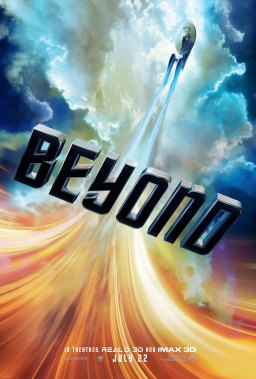
STB_Enterprise_Cloud_Beyond_Teaser_1SheetStar Trek Beyond released today on the 50th anniversary of the Star Trek television series. To celebrate the golden anniversary, the make-up team based in Los Angeles, Vancouver, and Dubai, set out to create 50 unique alien races to appear in the film. In reality, the final count was 53 plus all the versions of characters within each race.

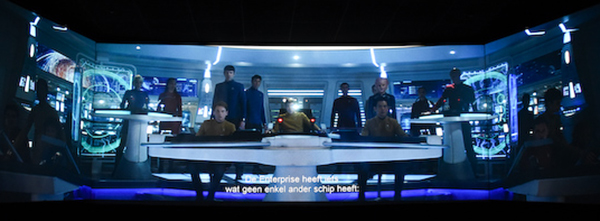
The movie was the first in the Star Trek series to step away from film. The digital equipment was selected for various reasons, but the most important was its ability to extend the frame with additional information. While there are only 30 theaters that will show the extended imagery, Star Trek is being lauded for its advancements with Barco Escape.

Barco Escape projection equipment allows the theater to show the movie not only on the main front screen, but also on the two sidewalls as well. This gives the audience a sense of being in the story or location that fills their periphery. Since most of the locations are created with CGI, it was easy to extend the scenes to incorporate additional information without having to worry about film grain.
barco-escape-star-trek-beyond-2

Selected theaters attached two additional screens on the sidewalls. This process was first tested with The Maze Runner in 15 theaters. Modifications from lessons learned were incorporated into the Star Trek release. It’s hard to say if the audience will appreciate being more absorbed in the visuals, or if it will just be the next gimmick in theatrical marketing.

STAR TREK BEYOND

Left to right: Chris Pine plays Kirk, Sofia Boutella plays Jaylah and Anton Yelchin plays Chekov in Star Trek Beyond from Paramount Pictures, Skydance, Bad Robot, Sneaky Shark and Perfect Storm Entertainment

The good news is that regardless of which of the five release formats you watch, including IMAX and 3D, the story is strong enough to stand on its own. The character development is in keeping with what made the series successful and the visual effects incorporate nods to Inception and Star Wars.

The story is easy to follow and the adventure fuels enough energy to excite the audience throughout the film. The character development including Scotty’s probable love interest is sufficient to make each character relatable to the audience. This juxtaposition of adrenalin, humor and honor is sure to make fans believe Rodenberry’s vision to be just around the corner: a huge society of all kinds of people and aliens co-existing peacefully.

Copyright © 2016 by CJ Powers

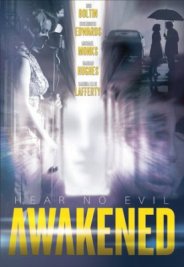
Awakened (Faith-Based Thriller) – Review

Screen Shot 2016-05-19 at 9.35.19 PM
I receive numerous films to critique, but I only take time to review the ones that have something unique to offer. So you can imagine my surprise to get a copy of a “faith-based thriller.” It was an oxymoron that I had to watch to satisfy my curiosity.

Faith-based films are slow, filled with preaching and mostly display low production value. Thrillers are mysterious, increase in intensity and speed of storytelling until the climax. The juxtaposition of the two made me curious, as I had to learn how the co-directors accomplished this feat.

The novelty of the concept peaked my interest when I learned the film won three festival awards and was awarded four Doves for family-friendly content. I had no idea how a thriller could be family-friendly, so I couldn’t wait to watch the film.

The faith-based elements of the film was certainly in place with a very slow pace that caused me to doze off three times. The preaching was intact with numerous quoted scriptures and a half dozen preaching moments. And, the production values were extremely poor.

The thriller side never ramped up its pace, nor did it compell me to watch the film until the last reveal. In fact, most of the thriller moments were more horror oriented and badly executed. I suppose I could say the film was horr-ible.

Co-directors Eugene Cuevas and Brian R. Reed shared the creation of several short films together, but this first feature length film of theirs was a bust. Hopefully they learned valuable insights into filmmaking from this disaster.

mediasI also hope that the three festivals that awarded the film for Best Visual Effects, Best Film and Best Feature Film have learned not to put their seal of approval on bad films. I can understand the desire to award the least worst film when a festival isn’t able to draw in great filmmakers, but the only way bad faith-based films and thrillers will ever improve is when only great films receive awards.

In case you’re wondering, the story is about a journalist who is captivated by a demon in the wake of losing his job. The demon appears in the form of a sexy 1960’s blues singer who convinces him to seek out the real story of her death. But thankfully, his spiritual wife realizes that sometimes the right hand has to help the left hand, so she does battle to save her husband.

The man feels like a “nobody” at the beginning of the film and demonstrates that he is a “nobody” at the end of the film. He doesn’t change or grow, so I’m not sure why the story was about him. She, on the other hand, is wise in the beginning and becomes more spiritual for her husband’s sake, by the end of the story.

For this film to receive four Doves for being family-friendly, someone had to have fallen asleep during its viewing and didn’t want anyone to know about it. With the poltergeist scenes of pictures flying off the wall and the bed sheet sitting up in the form of a dead woman, I’m not sure I’d view it as family-friendly. Not to mention the movement of the dead woman’s facial skin toward the end of the film.

My curiosity of how the co-directors merged faith-based and thriller genres has been quenched – They failed. Two diametrically opposed genres cannot be merged into anything worth watching. Rather than purchasing this DVD, take your family out to see The Jungle Book.

Copyright © 2016 by CJ Powers

Ewan McGregor’s Last Days in the Desert — Review

LDD_01006.CR2

Finding out that Ewan McGreger stared in the film selected by AFI FEST and SUNDANCE, I felt it was a work that I needed to see during the launch of its limited release. I was also eager to see McGregor play both Jesus and Satan. While there were several moments of great value, the film was boring and diametrically opposed to scripture.

The premise of the film is a three-day journey for Jesus returning to Jerusalem after his 40 days of fasting in the desert. The exploration of this “what if” artistic expression found the filmmaker ignorant of the scriptures or not caring.

In fact, the inaccuracy and mishandling of scriptures was so bad, NPR raved about how excellent the film was and classified it to be as good as “The Last Temptation of Christ,” which Evangelical leaders declared blasphemous in 1988.

The first problem with this film is that Satan continues to tempt Jesus over the three-day journey back home. In the scriptures, after Jesus resisted the devil three times, using scripture, Satan flees. Their ongoing battle shows the two almost chummy in nature with Jesus calling on Satan to show him a boy’s future through divination. I counted seven of these types of inaccuracies.

The cinematography by Academy Award winning cinematographer Emmanuel Lubezki was very well done, but the beauty of the picture was not enough to offset the confusion of story and a bad story structure.

The film is clearly presented as a story of Jesus, but the story unfolds about a boy that Jesus encounters. While a person might jump to the conclusion that it’s a story within a story, the idea fails to launch.

The parents of the boy are the most interesting of characters, save for Satan. The boy comes next and Jesus is the most passive person of little interest. Even director Rodrigo García shared his fascination for the parents and Satan and how he tried to compensate, bringing more life to the character of Jesus.

The biggest shock to me was the reaction of the audience after the lights came up. Most people raved about the film, dismissing the long boring parts and the mishandling of scripture. One person said that they understood the director’s choices based on artistic license and hoped the film would generate more like it.

While the film was a great discussion starter, it failed to entertain and it took faith-based films back to the Stone Age – Although, it was not promoted as a faith-based film due to its inaccurate content. And, while it was a selection of two notable festivals, it didn’t win a single award.

Copyright © 2016 by CJ Powers