
Creating a Polished Presentation

I was thinking about what it would take to create a polished presentation that would “WOW” the socks off of people. The work would require a new creative approach to take people on an emotional and educational ride that they’ve never been on before. The new method in and of itself would be refreshing.

My mind jumped to a chapter from “The Imagineering Workout” by the Disney Imagineers. Susan Dain, an Imagineer Show Designer, shared some of her notes about how to produce the perfect finishing touches to make a magical product. I took sketchnotes as I reread her four paragraphs, but I used my perspective of creating a polished presentation as a filter.

Here are my sketchnotes followed by an example:
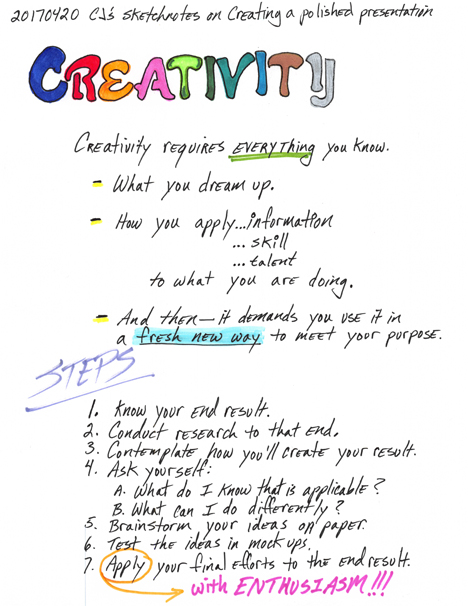
 

2017_04_20_sketchnote_v2

After reviewing my notes, instead of giving a polished presentation example, I’ve decided to share a creative example from my son and his family’s recent move. When I walked into my granddaughter’s new bedroom I was elated with the uniqueness of its layout. It made the room special, which in my mind requires an extraordinary design.

Using everything stored in my brain and heart, I started to dream up several ideas. More specifically, I wondered how the room could be designed to cause my granddaughter to smile from ear to ear like she does every time I visit her.

Creating a design that would make someone smile in that special way takes a tremendous amount of energy to apply all the information it would take, plus the use of skills and whatever talents can be tapped into for the project. And then, it’s time to figure out a fresh new way of combining everything into the purpose of making her smile every time she wakes up and every evening before closing her eyes at bedtime.

It would take brainstorming and mock ups galore. Until that moment when I’d realize that the best idea has been captured and figured out. Then, and only then, would it be time to approach her room with paint, thing-a-ma-bobs and do-hickeys.

But alas, I wouldn’t be able to do it, as her parents would want to help her design the room as a family activity.

It’s a good thing the creative process is fun and rewarding.

I can’t wait to see what she does with her room.
© 2017 by CJ Powers

Collaboration and Mock-Ups

Smartwatch_Arsenal_v2

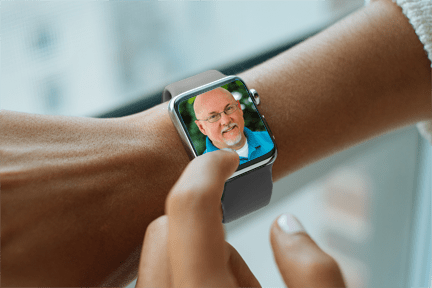
Sample Mock-Up

The best products come from the collaboration process and use mock-ups to perfect the concept early in the development stage. Wedding planners use 2D mock-ups to determine seating arrangements. Book publishers use 3D mock-ups to photograph books before they are printed. Filmmakers tend to create mood reels to promote film concepts in need of funds.

Regardless of the project, creativity is key in the collaboration process, which drives some form of mock-up. The tool allows the team to visualize spatial relationships, size and details. It also improves communication and an understanding of how the product impacts the human condition – the customer.

Every businessperson can benefit from using mock-ups by following three key principles.

SPEED

Rapid prototyping has been alive for centuries. It’s ideal for finding the flaws in a product quickly. A mock-up of a book’s main photo or background with typography can be quickly discerned as being too small or the wrong color. The faster you learn what doesn’t work, the sooner the ideal look comes into play.

The playfulness of the mock-up process stimulates creativity that one-ups the previous concepts. Each step moves the creators a step closer to their final design and a clear understanding of the products use and feel. Rapid prototyping trims off months of development as it brings focus to flaws that are quickly corrected.

MASS

Transferring the conceptual into the physical realm gives creators an understanding of the complexities and vast details required to polish the details of their product before production. This not only saves large sums of money, but it also alerts the team to the depth of focus required to turn their imagination into reality.

Without understanding the massiveness of the project, creators are often blindsided by the large scope of their concept. Few professional filmmakers start shooting a script without first counting the cost of time and effort involved in shooting 1,400 – 1,800 shots that it takes to make their picture.

IMPACT

The human condition rarely makes its path known in the ever-changing structure of society. Focus groups are used to hone in on a plausible direction by observing potential customers interacting with a prototype. The perceptions brought to bear by various age groups and other demographic profiles help the team redefine their key market segment.

Since 80% of all books are bought based on its cover design and 15% from the book’s back cover copy, authors are able to obtain advanced customer responses with prototypes. Speakers can test the impact of their topics with one-sheets and sales people can explore presentations with previz.

All collaborators can make use of mock-ups and vision boards to get a sense of how the service or product will make a difference in their marketplace. By focusing on the speed, mass and impact an idea will generate, the team is able to find its flaws and make the necessary improvements so release day is a rewarding celebration.

Copyright © 2016 by CJ Powers


Leveraging the Creative Subconscious

CreativeAfter watching a dozen documentaries about screenwriters, designers, directors and editors, I’ve come to the conclusion that these artists, at least the good ones, know how to leverage their subconscious. The art they create not only has a footing in reality, but their perspective is greatly enhanced by a highly creative filter from deep within the right side of their brain and their heart.

The most exhilarating creative ideas that pop into my head come early in the morning or at times when my mind is off playing or well rested. The pros take advantage of those moments to strengthen their work and bring new entertainment value to bear. This same moment allowed me to write this blog in the fraction of time it normally takes.

To leverage this strength, my friend David did creative work in the morning and analytical work in the afternoon when logic ruled his mindset. That’s not to say he was never creative in the afternoon, but the level of creative play was typically reduced after hours of exploration and work.

There are three commonalities among professional creatives that are worth understanding.

PLAY

Deadlines and pressure never increase creativity, but the opposite magnifies the creative flow. The strongest fuel of imagination is play. It’s made up of the same elements we explored as children and allows our inner child to come out to have fun. It can’t be taught or demanded, it can only be given a safe environment in which to let go so the creative can be free to pretend.

Play allows hearts to touch or bond without being romantic, which non-creatives don’t get, as they’re convinced something more has to be there, but its not. Play also allows passion to rise and solidifies why a work of art is important. Without it, people can’t understand what the artist saw in the work.

PROCRASTINATE

Non-creatives who have watched the procrastination process of the artist assume the person is lazy; not realizing their mind is going a million miles per hour. The percolation process is what gives flavor to the creatives’ work. A long bought of what appears to be boredom turns into aggressive workflow that can easily go late into the night or until the creative has to flop onto his bed.

Many creatives will plan ahead for their moments of procrastination by determining in advance the item they want to ponder. Most find their breakthrough by morning or in the drifting of their mind. Harnessing this natural phenomenon gives professionals an added benefit of what appears to be a secret weapon of the imagination.

OBSERVE

The best writers I’ve met or learned about through blogs and short films take time to watch a movie every day. They also peruse scrapbooks, magazines and other mind stimulating products. Not only do the myriad of observations fill them with ideas, but it also helps them to know what to avoid because it has already been done.

The most fun is watching others live their lives. People have the funniest idiosyncrasies that inspire. While some might suggest these oddities are a sign of the person’s weakness, the artist sees it as their humanity emerging in a unique fashion. These peculiarities make the person wholly them.

Being able to leverage the elements that feed the subconscious, the creative can explore matters of the heart like no one else. The more this process was protected by society, the greater was the renaissance of the time. It’s no wonder that most movements were birthed in the church, which at one time was a protected place for many hearts before the decades of judgment that ensued.

Over this weekend, as America celebrates its Independence, find time to play, procrastinate and observe. See if anything arises within your soul that must be reduced to some form or expression of art. Take this weekend to determine if being more creative will give you insights into humanity and a wisdom found by few.