Getting Past the White Blank Paper

A common question I get is, “How do you get past staring at that blank white sheet of paper when you create?”

My answer, “I doodle on it until it’s no longer intimidating.”

The key to any creative project is getting started. You can start at the beginning, the middle or the end, as all elements will have a part in the final creative piece. It might take on a different form or launch you into a better direction or story, but all elements are part of the journey that develops the idea into something worth sharing.

I remember being mesmerized as a little kid watching Mary Poppins. She was wholesome, magical and very smart. When Jane and Michael struggled to clean up their room, she reminded them that, “A job begun is half done.” This statement proved to be true in life and helped me understand the three things necessary to move a creative idea through to completion.

  1. Start Anywhere and in Anyway.

IMG_3363Creatives tend to start with a doodled idea on the nearby napkin. I’ve yet to meet a great film director who doesn’t have doodles in the margins of his notebook. It’s a natural process for creatives to doodle out ideas and turn them into something greater than intended.

For some, clipping magazines for a vision board will kick their ideas off in a powerful way. Others create living reels, storyboards and mood reels. Another might shoot off lots of photos, stick them on the wall and arrange them to find a potential story. There is no wrong answer to spark ideas that can cross over to your next big thing.

  1. Improve Upon the Idea

Once the creativity has been started, the refining process kicks into gear. All first ideas lack luster and rarely fit the final work of art. The journey of creation requires rework 80% of the time to bring the art to life. Three steps will help the creative hone their ideas…

  • What If: Asking what if questions force the mind to consider multiple angles and perspectives on the art. By interrogating the idea for all possible vantage points, a richness of greater value is added to the work.
  • Examine & Re-examine: Focusing in on the craft and bringing the idea to a master level allows the creative to determine the best possible way to share the story or idea. Instead of retelling the age-old story of Sleeping Beauty, Disney diverged from its standards and told the story of Maleficent. Critical and creative thinking can help this process explore new avenues of possibilities.
  • Inspire with Imagery: Finding quotes, verses or images that spark emotions related to your idea will inspire and move the process forward. The creative always welcomes the possibility of sparking something new that polishes an idea or brings it into a unique and fascinating light.
  1. Add Magic

The sparkle or the ah-ha moment lifts the idea above scrutiny. That simple element of magic also transforms the art into something entertaining that must be talked about among friends. Whether it’s a unique moment in a story, the juxtaposition of two seemingly unrelated items, or an uncanny perspective that enlightens, the magic gives the art wings to transcend the culture to something better than its current state.

Get started in anyway you choose and then recreate to make your work better and better, until you finally find the magic element that will make your idea worth sharing by others. It doesn’t matter if your audience is a business team, little children or out of town relatives, everyone needs to be entertained enough to open their minds to your shared idea.

Copyright © 2016 by CJ Powers


Labeling the Creative

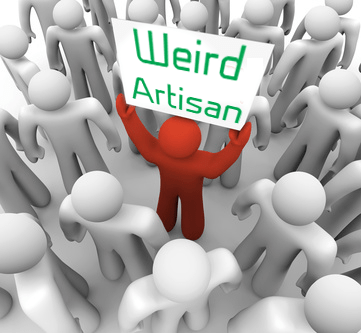
LabelLabels are dreadful, even the good ones. All too often people try to categorize what they don’t understand, as if it will bring a sense of security where its not needed. The creative spirit is allusive to many and requires a label from the logical to understand why a person is unconventional.

I’ve been called unique, weird, innovative, imaginative and creative. Each label was an attempt on the person’s part to categorize me into something close to what they understand. They’re uncomfortable with me not living life in what they believe to be an appropriate manner – A lifestyle based on logic.

Most get away with slapping a label on a creative because the majority of people require the same. I’ve read estimates that there is one creative person for every 10,000 logical people. That means for every motion picture cast and crew of 300 people, there are 3 million who don’t have a clue how to relate with those creatives. However, not knowing how to interact with a creative doesn’t stop the 3 million from enjoying their film.

The good news is that most creatives have had to learn how to relate to their audiences and investors in a logical fashion. Since the creative is capable of living in both worlds, at least for a time, the one looking for fans and funds bridges the gap.

This dynamic relationship drives a certain level of fandom based solely on the unknown. Every performance or released product appears to be all the more entertaining as the creative gives fans glimpses into their soul – The most rewarding form of story.

After reading a heartwarming story, one person told me the author had talent or the ability to achieve what others cannot achieve. His friend politely disagreed and argued that the author was a genius, as defined by German philosopher Arthur Schopenhauer. His writings suggested that genius rises from a superior capacity for contemplation that leads the artist to transcend the smallness of ego and enter the infinite world of ideas.

I suggested that the cautionary tale of artistry was the person who isn’t truly creative, but puts on the appearance of the artist. He can notably get stuck in his own ego based on the rise of fandom. However, the true creative continues to create regardless of those who appreciate his creative bent.

I’m not suggesting that all creatives are naturally humble, but the ones I’ve met create because of who they are, not how many fans they obtain. The creative flourishes during the time people notice his work and during the time no one takes notice.

Schopenhauer said, “The man in whom genius lives and works is easily distinguished by his glance, which is both keen and steady, and bears the stamp of perception, of contemplation.”

There may be a parallel in how my friends argued about genius and my perspective of artistry. I define a creative as someone who observes and contemplates the very perceptions he has acquired, in order to reduce it to a medium for public consumption. Genius or not, there’s no room for ego or labels with the artist, as he must move from philosophies to thoughts, spreading the life changing ideas the public is so hungry to receive.

Copyright © 2016 by CJ Powers

Leveraging the Creative Subconscious

CreativeAfter watching a dozen documentaries about screenwriters, designers, directors and editors, I’ve come to the conclusion that these artists, at least the good ones, know how to leverage their subconscious. The art they create not only has a footing in reality, but their perspective is greatly enhanced by a highly creative filter from deep within the right side of their brain and their heart.

The most exhilarating creative ideas that pop into my head come early in the morning or at times when my mind is off playing or well rested. The pros take advantage of those moments to strengthen their work and bring new entertainment value to bear. This same moment allowed me to write this blog in the fraction of time it normally takes.

To leverage this strength, my friend David did creative work in the morning and analytical work in the afternoon when logic ruled his mindset. That’s not to say he was never creative in the afternoon, but the level of creative play was typically reduced after hours of exploration and work.

There are three commonalities among professional creatives that are worth understanding.

PLAY

Deadlines and pressure never increase creativity, but the opposite magnifies the creative flow. The strongest fuel of imagination is play. It’s made up of the same elements we explored as children and allows our inner child to come out to have fun. It can’t be taught or demanded, it can only be given a safe environment in which to let go so the creative can be free to pretend.

Play allows hearts to touch or bond without being romantic, which non-creatives don’t get, as they’re convinced something more has to be there, but its not. Play also allows passion to rise and solidifies why a work of art is important. Without it, people can’t understand what the artist saw in the work.

PROCRASTINATE

Non-creatives who have watched the procrastination process of the artist assume the person is lazy; not realizing their mind is going a million miles per hour. The percolation process is what gives flavor to the creatives’ work. A long bought of what appears to be boredom turns into aggressive workflow that can easily go late into the night or until the creative has to flop onto his bed.

Many creatives will plan ahead for their moments of procrastination by determining in advance the item they want to ponder. Most find their breakthrough by morning or in the drifting of their mind. Harnessing this natural phenomenon gives professionals an added benefit of what appears to be a secret weapon of the imagination.

OBSERVE

The best writers I’ve met or learned about through blogs and short films take time to watch a movie every day. They also peruse scrapbooks, magazines and other mind stimulating products. Not only do the myriad of observations fill them with ideas, but it also helps them to know what to avoid because it has already been done.

The most fun is watching others live their lives. People have the funniest idiosyncrasies that inspire. While some might suggest these oddities are a sign of the person’s weakness, the artist sees it as their humanity emerging in a unique fashion. These peculiarities make the person wholly them.

Being able to leverage the elements that feed the subconscious, the creative can explore matters of the heart like no one else. The more this process was protected by society, the greater was the renaissance of the time. It’s no wonder that most movements were birthed in the church, which at one time was a protected place for many hearts before the decades of judgment that ensued.

Over this weekend, as America celebrates its Independence, find time to play, procrastinate and observe. See if anything arises within your soul that must be reduced to some form or expression of art. Take this weekend to determine if being more creative will give you insights into humanity and a wisdom found by few.