
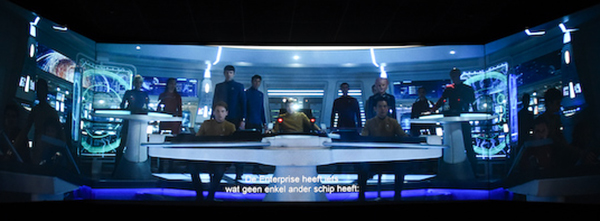
Star Trek vs. Faith-Based Canon

barco-escape-star-trek-beyond-2

Star Trek is one of the most revered science fiction franchises that hold tightly to its canon. The 13 motion pictures and 6 television series all follow the production bibles that have painstakingly been kept corruption free for 50 years. Even the independent fan films have focused on excruciating details to honor the canon.

A recent copyright infringement suit sped its first part of judgment thanks to the accuracy of the canon and the many production companies that continued adhering to the rules of the franchise world without exception. Many Star Trek bible elements have been released and highly supported by the fans, forcing production companies to scrutinize every aspect of their production in order to stay true to its canon.

But in the faith-based films that include stories based on the Bible, a canon of 66 books, few production companies adhere to it. The Young Messiah was released last March and was touted as one of the best faith-based films of 2016, but it broke canon with little repercussions.

The film is a story about Jesus at age seven and his family’s departure from Egypt to return back to Nazareth. This fresh childhood perspective gave audiences an explorative glimpse into how their future Savior grew into his religious identity.

Breaking canon in the name of “creative license” is something that Star Trek storytellers would never do. But, the makers of The Young Messiah had no problems stepping away from canon. According to the book of John, one of the 66 books within the Christian canon, Jesus performed his first “sign” or miracle at the wedding in Cana of Galilee. But, in the film, which takes place years earlier, he brought a dead bird back to life, healed his sick uncle and restored sight to a Rabbi.

While the director intended these signs to reveal the humanity of Jesus, which it did, it broke canon and distorted the truth for its viewers. This creates conflict between those defending faith-based films and those who teach from the canon in real life. And it doesn’t end there.

Back in the 1960’s a group of historical revisionists decided to adjust the thinking of the church through the media. They created a story that Jesus’ hands weren’t actually pierced when he was put on the cross because the Greek word for hand also included the wrist. They also stated that Jesus’ hands would’ve torn open due to his weight, and therefore, he was actually pierced in his wrists when they crucified him.

This notion broke canon, but evangelists liked the “new revelation” and spread the word throughout the world. Today, most pastors who weren’t around for the origin of this story teach that Jesus was pierced in his forearms, albeit close to the wrist. They shifted to the forearm because the wrist is just a series of bones that couldn’t be pierced, and the canon said not a bone in his body was broken, which piercing his wrist would have done. These further adjustments took congregations even farther away from the purity of the canon.

By the way, a couple years ago I interviewed a nurse who worked for an orthopedic hand surgeon. She said that Jesus could easily have been pierced in his hands because of the vast network of ligaments that crisscross like a web inside of the hand, which is also strong enough to hold the body’s weight without tearing.

This Easter a new faith-based film that has broken canon will be released by the title of The Shack. The most obvious departure from canon is that God the Father shows up as God the Mother. Canon states that God wanted to be called the Heavenly Father, but historical revisionists are pushing for God being able to show himself as anything he wants, which meets the canon of the Hindus and Universalists, not the Christians.

What I don’t understand is how Christians, whose lives depend on its writings, are so willing to break canon in the name of creative license, but Star Trek will do everything in its power to maintain their sacred canon. Even J. J. Abrams during the filming of Star Trek 2009 talked about the difficulty in maintaining canon, but how it was well rewarded by the audience’s appreciation.

So, why do faith-based films not follow canon? I’d love to hear your thoughts on the matter, especially since Star Trek is make believe (suggesting that canon doesn’t matter) and Christianity is reality (suggesting canon is critical).

Copyright © 2017 by CJ Powers

Turning Right into Creativity

Security camerasWhen I first met the spy, I thought he was kidding about his occupation. However, his explanations were plausible, so I listened further. It wasn’t until he started teaching me how to escape from a populated area that I knew he was telling the truth. Well, that is except for his name. I’m certain the personal information he shared was not real.

The best way to escape from any arduous state of affairs is to plan alternative routes in advance of a dicey situation. The preplanning process must be nonchalant and atypical of the most efficient route that we all conform to over time. This is true within the creative world, which helped me relate the need to escape with high-pressured creative sessions.

Here are the three spy lessons that have helped my creativity.

TURN RIGHT, NOT LEFT

To draw from your creative instincts during intense circumstances is like the spy who has to shift to his plan “B.” The man told me the first step in creating an alternate route is to turn right at your normal first left turn. This sends you in the opposite direction and forces you to make new decisions in developing a B-route.

During a creative session, at the first observable moment that a story beat is supposed to happen, its time to turn right into a new creative perspective. Coming up with a completely unexpected turning point in a story propels the characters into a mode of exploration. Further development is required to determine what direction or next step they must follow to survive.

Spies like unexpected twists in circumstances since few can guess what their next move might be. Only the well-prepared plan-B can help the spy survive the new reality as it unfolds, losing those who attempt to follow. Due diligence during the exploration phase will empower the spy to move quickly during the execution of the plan.

The search for new routes or creative viewpoints forces us to be alert. We are no longer able to function on autopilot, which helps us to avoid traps hidden within our customary creative reserves. When we lose the ability to rely on our habits to get by, we’re forced to innovate and keep one step ahead of the audience.

SKETCH NOTE NEW SURROUNDINGS

The spy told me to turn right and drive for a block or two, then pullover and sketch note everything I observe. The notes would be like a location scouting report with enough picture detail for strategic planning. Once the sketches are complete, he suggested I drive a couple more blocks, stop and repeat the process.

It was also important to figure out what the common next step might be for the average thinker and establish an unexpected action. This choice would then lead me down a new road for a couple of blocks. I’d then pull over and sketch again. Capturing every detail helps the spy during rapid escapes, and helps me during intense creative sessions.

WORK PLAN “C”, “D”, AND “E”

When on the run, spies know their pursuer is trying to out guess their every move to get two steps ahead of them. Those with great manpower throw several agents against the half-dozen possibilities with the hope that one will capture the spy or at least learn his next steps.

In the creative world, there are always a few in the audience who try to figure out where the story is headed before it gets there. I’m one of those who can usually guess the ending ten minutes into the film. Few movies startle me with interesting plot points that captivate my attention with surprise. When a director has multiple plans to draw from the audience is typically amazed at the new and fresh ending.

Pixar is known for brainstorming a dozen endings and then throwing them away for the sake of coming up with that one new idea no one thought about. Their productions take extra time to develop because they don’t want anything to seem old. They work every possible plan until they find the one that stirs the audience with both delight and surprise.

Meeting the spy gave me some interesting viewpoints to consider within my realm of communication and creativity. I even learned how to back into parking spaces for quick get-a-ways. But, there was one other thing I learned from the spy that bothered me. He said, “And whatever you do, don’t trust anything a spy says because he’s probably using you as a disposable asset in the moment.”

As the man disappeared from my sight, I realized that he might have lied about being a spy. And if he did lie, could I trust what he taught me? Certainly if he had told the truth, it was clear that I couldn’t trust a single word he had shared. Hmm, maybe the lessons in today’s blog aren’t lessons at all.

Copyright © 2016 by CJ Powers

Recipient of 2017 Torch Award

Photos by: Sean Su @[203867963313063:0]I was thrilled to be a part of the management team that created and implemented an ethical business model, especially since it was acknowledged and rewarded by the Better Business Bureau (BBB). We received Honorable Mention for businesses in the 1-9 employee category at the 2017 Torch Awards for Marketplace Ethics.

The BBB received over a thousand nominations from consumers and businesses in Illinois. The awards banquet was sponsored by numerous companies serving Chicago and Northern Illinois. Present for the award presentations were WGN, ABC, and the WCIU.

Photos by: Sean Su @[203867963313063:0]ABC 7’s Hosea Sanders hosted the event and handed out the awards. Melissa Stockwell, Army war hero, mother and three-time world champion Paratriathlon medalist was the keynote speaker. The event was well attended by 400 plus Illinois business leaders.

I was given three minutes to share highlights from our ethical practices, journey and gratitude for the award. It was the first time I received an award of that magnitude on behalf of a team and I found myself extremely nervous until my foot hit the stage. Once on the platform I quickly came up with a new speech, since Sanders touched on my planned comments as he introduced me.

Photos by: Sean Su @[203867963313063:0]During the selection process I was inundated with 25-30 hours of paperwork. Our final document answering the questions of the third party counsel was just shy of 50 pages including process and event documentation for standards adhered to and lived out.

I was energized by this once in a lifetime experience because everyone in the room was passionate about raising ethical standards in Illinois. Being in a room with like minded executives was encouraging and I hoped each company effectively instills within their employees the need for and benefits of working within ethical standards.

Photos by: Sean Su @[203867963313063:0]