
Creativity: Gift or Craft

I heard a podcast with stand up comedians Ken Davis and Bob Stromberg talking about creativity. The one thing that stood out worth sharing was that neither man felt creativity was a gift. To clarify, they defined the “gift” as the capacity and desire to create, while they said “creativity” is a learned craft that everyone can practice.

I agree that everyone can be creative especially when following these 5 practical steps that I use:

1. Capture

The first step in being creative is capturing the things that stir the emotions. When I capture in a quick note or sketch the thing that impacted me or moved me, I’m able to remember it and give it my full consideration.

2. Explore

Once I’ve captured the moment, I then explore why it touched me. I ask myself questions in an attempt to learn the truth about why I felt the humorous or dramatic moment.

3. Birth an Idea

When I contemplate or meditate on the very thing that I chose to explore, new creative ideas pop into my mind. The one that makes the greatest impression fuels the fire of passion, giving me an opportunity to flesh out the concept in the form of an artistic expression.

4. Play

People stop being creative when they stop playing. It’s therefore important to play around with variations of the new artistic idea. Rather than searching for the one “right” answer to present, playfulness requires exploring multiple right answers to find the most entertaining one that clarifies the message.

5. Polish

Assessing the presentation or performance with a test audience helps me figure out what worked and what didn’t work. More importantly, I learn what the audience understood or missed. This new gained knowledge gives me a chance to tweak and polish my creative idea for its final and official production.

Being creative is a choice that requires a playful viewpoint while developing the craft. Everyone is capable of being creative, but not everyone chooses to work hard at capturing the emotional elements required to be successful. Fortunately the first step is child’s play, which everyone is capable of because we all know what its like having been a child.
© 2017 by CJ Powers

Grandma’s Empty Story Chair

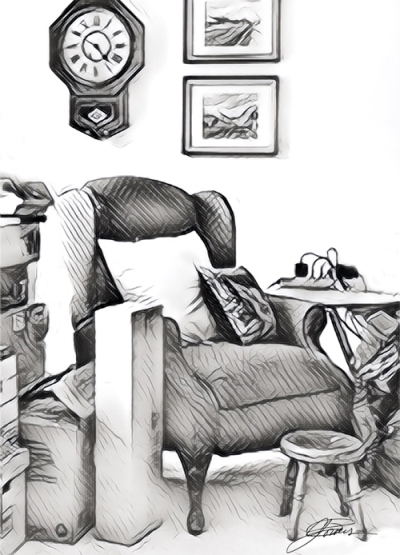
Grandma's Empty Story ChairMy favorite chair sits empty today, crowded in by boxes of stuff I collected over the years. Some of it will see its demise in the dumpster out back, while the more contemporary pieces will be given a home thanks to a local mission or charity.

When I left this world, I was freed from the days I spent in darkness. Having perfect sight again makes this new life extraordinary. My skin is silky smooth and my new body has no stretch marks from the excess weight I once carried on earth. I wish my great grandkids could see me this way.

I can barely remember the fear in the little one’s eyes as she reached out to touch my aged, wrinkled skin. The discoloration from medication gave my arm an eerie and deathly bluish shade. The texture alone was enough to startle any three year old, but I was glad she screwed her courage to the sticking place.

My heart raced with joy when her soft fingers touched my fragile skin. Caution was quickly voiced from my kids for my skin could be too easily torn—but I needed my great granddaughter’s touch regardless of the risk. Her loving, yet hesitant touch, gently slipped away and I fell back into my distant prison of old age. Always feeling alive, while trapped in a decaying body that no longer responded as I willed.

Now, glancing at my empty chair brings a subtle note of joy. I was glad for the opportunities I had, although few, to share stories from a time long ago. My son listened attentively to each tale and responded with questions that taxed my memory, as he searched for enough detail to remember my younger years going forward.

My daughter was also eager to learn more about my life including the love interest I had before meeting her father. She was the most empathetic person that listened to my stories and understood the value of each object I amassed over the years. The symbols were reminiscent of several life-impacting stories that I lived out and my daughter could retell most of them just by looking at the piece collected.

But today the boxes are being tossed because the grandkids and great grandkids see no value in any of it. My stories are fading as each representation rusts away or turns to dust. My empty story chair will soon be pitched, as its worn-torn look no longer matches the decorative styles of the day. And with it, I’m afraid family members will no longer cherish my remarkable stories.

Oh, my daughter will continue to share several stories, and my son will even share a few, too. But even he will one day contemplate the waning interest by his children and their kids. His time will become finite and he will have to choose between sharing one of my wonderful stories or making sure his grandkids listen to one of his. I would never wish that frustration on him.

Instead, if I could encourage him right now, I’d say…

Grandma’s story chair is empty and the artifacts surrounding it no longer speak of the thrilling life I led, so say goodbye to me once again, not fearing that I’ll permanently fade from your memories, and speak into the lives of your kids, grandkids and their kids. For you are of great value to me and I want your stories to resound with compassion and wisdom that will bless our family for generations to come.

NOTE: The sketch illustration was created by CJ in an attempt to make his story feel real. While not an illustration artist, CJ used his Bamboo drawing tablet to sketch elements from his mother’s living room.

© 2017 by CJ Powers

Where Do I Sit?

Theater_Seats

The weekend has arrived and those dating are most likely headed out to dinner and a movie, but they don’t know where to sit in the theater. Most know to avoid the first few rows and some will make sure they don’t end up in the back of the theater unless they like being remote. But few know, for which seats the director designed the movie.

Theaters range in size and shape and follow the rudimentary formats prescribed by the National Association of Theater Owners and the Motion Picture Association of America. These formats are based on screen ratios and the projector’s “throw” of light based on lumens, curvature of the lens and the screens’ reflective material.

Let’s make it simple…

Without trying to figure out the complex formulas to determine seating placement, a well-designed theater will provide good seating about two thirds of the way back from the screen. Unfortunately that’s based on typical screens being about 20’ X 47’ and the theater having a total depth of… Nope, let’s keep it simple.

Have you ever attended the rehearsal of a stage show? Did you notice that the director always sits in a specific place? Or, how about at a concert venue, did you notice where the mixing board is located?

Microphone jacks are typically placed in the ideal location for the director to plug in his headset or microphone in professional, university and high school theaters. This gives him the closest view of the stage, while still being able to see the entire stage. If he moves closer, he can’t get the big picture. If he moves further back, he can’t focus on the detail.

In film, the same rule of thumb holds true. When a director is viewing his final mixed film, he is seated based on the screen location and surround sound speakers. Even in the mixing room the director is positioned in the ideal location and makes all the decisions based on that spot.

When the show releases to the silver screen the ideal location is about 2.5X the screen height back from the movie screen. If you select a seat in that location, you’ll notice surround speakers directly to the left and right of you. The entire movie was created based on those seats. Any other point of view changes the impact of the film.

For instance, if you don’t like horror films you can sit in the back to diminish the surprise factor and reduce the emotional pull on your heart. If you enjoy rollercoaster like action films you can move closer to the screen to keep your head moving and help your stomach churn your latest meal.

Regardless of the screening room size, you’re safe sitting 2.5X the screen height back from the screen in order to see the film as the director designed it.

© 2017 by CJ Powers

SaveSave