Surprising Contest Rewards

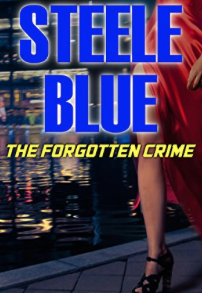
Having a screenplay making the rounds in the film festival circuit during a pandemic is a unique experience. It’s easy to be distracted and focused solely on the big win. In fact, I’ve neglected to realize the additional prizes and rewards that I might win. Since STEELE BLUE: The Forgotten Crime has placed, been a finalist, and a semi-finalist in various festivals, I’ve started receiving these “unexpected” rewards.
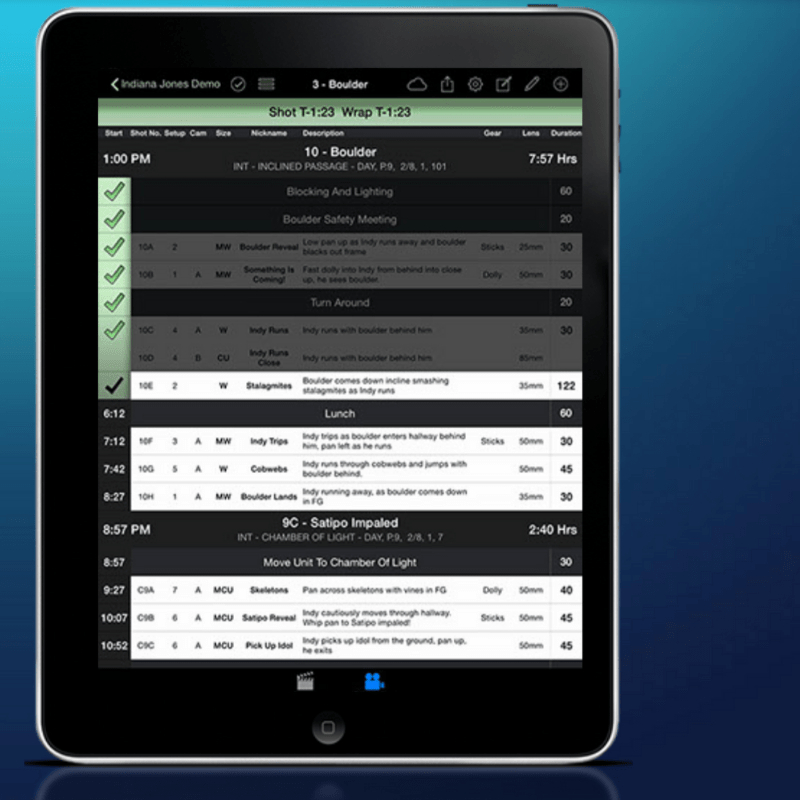
SHOTLISTER is an app I received that works on my laptop and iPad. The iPad version is actually free for a limited time for any filmmaker that wants to snap it up before it’s too late. The software allows a director to determine and schedule what scenes will be shot on a specific day. The app also provides a live mode to keep an eye on how many shots remain within a day’s shoot, which can easily be rescheduled. The depth of information that can be logged for each shot is amazing, although I’d keep the data at a higher level for my use.

The program is highly customizable and can be synched with the Director, AD, Producer, Script Supervisor, etc. The best part is that adjustments only take a few seconds instead of having someone run back to base camp in order to alter the day’s shoot. There is also a pro version that incorporates storyboards and other extras that independent filmmakers don’t typically have the luxury to use.

I’ve also received additional rewards including budget development for my script, a conversation with a distributor, and several consultations in the areas of development packaging, raising venture capital, and international advanced sales. Who knows what other benefits I might receive as my story continues on to the next festival.

The entertainment industry has always moved in waves and this timing is no exception. I’m speaking at a small book club next week that was just opened up from the book club to the entire clubhouse membership. That gives me a week to prepare a different type of talk should the outdoor venue rapidly grow. Either way, it will be a lot of fun.

Many of the judge’s comments led me to believe certain changes are needed to prepare the audience for the true-life portions of the screenplay, which some feel can’t be true (even though we all know life is stranger than fiction). Meeting with the club will give me an opportunity to test new material and get immediate feedback.

Well, I’m off to prepare for the next step on this journey. I’m also feeling a bit nostalgia based on the changes I’m making to the original story. The story seems to keep on improving from its original screenplay form to a book, and back to a screenplay—becoming a more entertaining story with each step. Hopefully everything will be just right the moment the film is given the green light.

© 2020 by CJ Powers

Semi-Finalist Screenplay

Making the circuit of film festivals as a screenwriter is difficult. Not because of the thousands of entries that your work competes against, but because when you don’t win there is always a reason. Hopefully it’s not that your script has inadequacies, but because there was a better story out there being told.

So far STEELE BLUE: The Forgotten Crime has made it into three festivals and was rejected by one. My story has placed, made it as a finalist, and a semi-finalist. While I’d like to pat myself on the back for writing a script that has gotten extremely far compared to the vast majority of submitted scripts, I tend to focus on the “why” of my story not working.

Please don’t get me wrong. I do appreciate my script being accepted in several genre specific, prominent and gold status festivals. But I’m realistic enough to know that there is always room to improve my story. Clearly the basis of the story isn’t bad, but the way I chose to tell it didn’t sit perfectly with a couple of judges and studio executives. This gives me an opportunity to find a better way to introduce certain elements to make the story easier for all audiences to embrace.

Based on the shared judge’s responses, I’ve learned that the factual oddities of PTSD are stranger than fiction and hard for judges to swallow. That’s right, the factual information I put into the story is what audiences have a hard time accepting. They love the death-defying truck chase on Lake Shore Drive in Chicago, which is barely plausible in its far-reaching fictionalization, but the truth of a specific type of PTSD makes the story unbelievable for some.

I need to better couch the truth or fictionalize the illness into something more palatable for the audience. Since the biggest issue is that some don’t accept the fact that people would live according to what a doctor prescribes, I have to consider demonstrating how that would play out. While this eats up critical story time, I have to make sure the world I’m building is plausible to the audience. After all, if they don’t buy into how this illness actually works, the entire action plotline crumbles.

These types of struggles are why only a small percentage of stories are written by one person. Many times it takes another perspective to round out a story so it’s more easily digested by a broader audience. But once the concept is accepted, the rest of the story flows as imagined.

Extending the opening of the story to show Cassie in her immediate PTSD home life, instead of jumping to eleven years later, should do the trick. Unfortunately, I have to cut several later scenes in the story to keep the film at a good length based on its genre. A few added scenes earlier in the picture won’t take but a few days to write, but cutting a few scenes out of a later portion of the movie could take weeks.

The strengthening of the story through this festival process causes me to question whether or not I go back and do a rewrite on the book. I can’t help but wonder if the same objections to the story exist with readers of the book.

I may have to consider a rewrite or be prepared for the audience to say the movie was better than the book—Since film is my first language, I’m okay with the film being a better story. However, I do like to make sure my stories are always the best they can be for all audiences.

© 2020 by CJ Powers

Placed in Competition

I received notification from a second festival this week that my screenplay had placed. While it was a wonderful honor, it wasn’t the big win. However, I was able to review the judge’s notes to learn how to better improve my story. And yes, in the meantime, I’m still waiting to hear results from several other festivals.

Reviewing the judge’s notes was an eye-opening experience. First, let me share a few of the positives.

STEELE BLUE: The Forgotten Crime is a strong, interesting script with a compelling premise. It’s a classic cop story with a psychological twist. The mystery aspect makes the story intriguing and keeps the audience engaged. The story moves at a consistent pace and maintains consistent tone, and the stakes are raised appropriately along the way. 

The script does a good job of making each character feel distinct and individual. Cassie is a great protagonist for the script, a “maverick” whose world is rocked by her slowly recovered memories. Her relationships on the force are varied in dynamic, but her begrudging bond with Samantha is a highlight. Her relationship with Kevin is also a major part of the script, and his… (okay, I’ll avoid the spoiler alert) …is one of the script’s best twists.

I was really happy with the positive comments. Each one reflected key elements that every great story requires. I feel like I really nailed the execution of the screenplay and made it visual enough that the judges were happy overall.

However, since the screenplay only placed, it meant that either there were several better stories in the competition or my story had a major flaw that overshadowed all the good points.

Instead of writing out the judge’s negative comments filled with lots of spoiler notations, making it hard to read, I thought that I’d share the concepts of each issue.

The judge made it clear that he or she thought there were two issues that held the story back. One was that the judge thought the PTSD information the doctor presents in the beginning of the film “seems a little unbelievable.”

When I was interviewed on a radio show during the release of the book version of the story, I explained the exact case information that the story was based on. The radio host suggested that sometimes life is stranger than fiction.

In fact, several interviews raised the same issue and each time I shared that the things I made up in the story everyone accepted without consideration, but the true PTSD case the story was drawn from seemed unbelievable to just about everyone. I was tempted to scrap the true events from the story and replace it with acceptable fiction. But I didn’t.

Okay, I’m going to interrupt the negative comments and share one more positive comment.

This is a well written script that feels polished and professional. The script makes good use of flashback to provide context and delivers exposition naturally. I enjoyed Steele Blue and could definitely see it coming to life on screen. 

Now that I feel a little better, I’ll share the second negative issue.

The judge suggested that I might have been trying to set up one particular twist in the film that he or she figured out before the ending. This led the judge to determine, “that the twist didn’t land.”

If the judge was paying attention to the very first few pages of the screenplay, he or she would have learned the answer to the alleged “attempted” twist. There wasn’t a twist.

From the first pages of the script, I let the audience in on a secret so they could watch and see how the main character responds to circumstances, as she is blinded from certain knowledge—all while the audience knows from the very beginning what is happening.

Of course, it is possible that the story pulled the judge so far into the character that he or she bonded, living in the moment as the main character experienced life’s moments.

While I suppose that is a good thing, it is also a bad thing.

The fact that the judge couldn’t totally follow the journey of exploration of the characters life and instead wanted a huge twist at the end of the film, suggests that maybe I should have approached the story from a very different perspective—keeping the audience in the dark throughout the film.

But I wrote this film as a female buddy cop story, not as a thriller. Yes, it is very much an action film, but again, I didn’t write it as a thriller. So maybe I need to ask myself how I might improve the story so future judges don’t decide it should be a thriller and mark the story down because it isn’t one.

Or, maybe I should just keep writing action/adventure stories laced with profound relationships and see if I can build an audience that like the types of stories I write.

As for the true-life PTSD information that seems unbelievable, maybe I stop worrying about educating the audience about real issues that victims face and instead just entertain them with made-up moments, which are more believable, but have no basis in the strange societal elements we all face.

In all reality, I’ll reread and rethink the judge’s comments another two dozen times before I settle on how to improve the story. In the meantime, there’s still hope that the other festivals where I’ve been accepted might have good news come announcement day. I’ll let you know once I get notified.

As for tomorrow, I’ll just be thankful that I’m able to tell stories for the screen. And who knows, maybe a few of them will get produced.

© 2020 by CJ Powers