
Four Types of Information We Communicate

I met a person from the Chicago Tribune this morning and discussed the changing market and presentation of news based on the Internet and people’s desire to go green. The conversation quickly shifted to something a bit more interesting for me – People’s expectations that everyone who works in media should know how to communicate.

Communication has four basic types of information that every person and couple might want to learn – Its just not for the media specialist. Before we can communicate the four areas of information, we need to understand its existence.

OPEN information is the first category that everyone participates in. This is the information that we know and others know. It is the given based on our history, personality types and common interests. Everyone belonging to a photography club understands what a lens is and can opening discuss it with any new member.

BLIND information is that which others see in us, but we don’t. It isn’t based on our denial, but rather on the perceptions of others. I recently gave a talk and was approached afterwards and thanked for the great information I shared and the entertaining way I presented it. I was blind to this perspective and had no clue that I came across in such a positive manner.

HIDDEN information are the types of things we withhold from other’s. It can be made up of things we are protecting the other person from or it can be kept to protect our own hearts. Telling a widow after the funeral that her husband was cheating on her does nothing, but tear down wonderful memories and feeds bitterness – Something not worth revealing.

UKNOWN information is that which exists that we, nor anyone else in our circle is familiar with. It still exists and might impact our relationships without our understanding. It can be both negative or positive, but can’t be changed until we know it exists. Although, some information can never be changed regardless of our new gained knowledge.

What few people realize is how we communicate these types of information. Some of us are oblivious to how our body language might reveal hidden information that the other person can see, but might not clearly understand at first. I met a woman two weeks ago who shared about her husband’s affair. Her gut told her something was going on, because she was reading his hidden information through his body language.

Another person shared with me how great a particular pastor was in delivering his message. He liked the pastor’s style because he didn’t realize how good he was. His innocence protected him from arrogance and was therefore far more effective in his talks than he knew.

Being conscious of how we share the information through body language and word choice makes all the difference in how the information is received. Those who know how to read body language are also well aware that what is not said can be just as powerful of a message. By being purposeful in what we share and how we share it, we are more likely to be clear and understood. It is our choice and it’s important to gain feedback to understand how we came across.
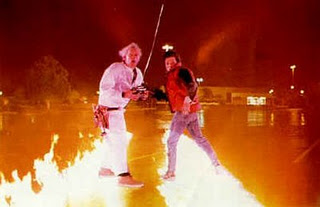
Set Pieces are the Latest Movie Tool

Gaffers, Best Boys and Set Pieces are terms unique to the film industry. Over the decades we learned that a Gaffer is the Chief Lighting Director or the Head Electrician, and a Best Boy is an assistant to either the Chief Electrician or the Key Grip (Head of the Grip department). But “Set Pieces,” we thought were a piece of stage scenery.

Set pieces are scenes that are designed to have an obvious imposing effect on the audience. They are the scenes in a film that are ideal for trailers. They are also the scenes that stand out and say this film is unique and special. When done correctly, they are the scenes that everyone remembers and creates a buzz about, driving more people to the movie.

Just about every movie is made up of Shakespeare’s three-act structure. Because films tended to die in the long second act, which is about half the length of a typical film, screenwriters split the second act into two segments: 2A and 2B. This was a natural decision as directors constantly wanted to do something special at the midpoint in the film.

Getting an entire industry to split the second act and use four segments within every film wasn’t difficult since the industry was used to films being delivered in eight 20-minute reels. These 20-minute reels had long ago driven stories to flow in sequences due to the projectionists having to physically change reels.

While the three-act structure is now written in four segments, each including two sequences, the responsibility is on the screenwriter to make sure the format doesn’t make the story boring. Thus, set pieces entered the picture.

Movies require a minimum of three set pieces to capture the audience. Some use four due to the split second act, while others try to have one set piece in every sequence. Today, there doesn’t seem to be any preset requirement due to the ever-changing variety of set pieces, level of creativity, and amount of budget.

A strong set piece lasts the test of time. Many will remember the light saber battle between Darth and Obi-wan Kenobi. Another iconic set piece was the scene where Indiana Jones runs away from the giant boulder. I’ll never forget the DeLorean racing across the wet mall parking lot and seeing it vanish into a pair of fire trails in Back to the Future.

Set pieces distinguish a film and drive the buzz that skyrockets a title to success. Unfortunately, few screenwriters create such scenes, as it takes a significant amount of time to develop and a vast amount of creativity. For these various reasons, spec scriptwriters rarely write iconic set pieces. However, when they do, numerous contracts follow – Something every screenwriter should consider.

Copyright © 2011 By CJ Powers

Elements of a Great Pitch

I had an opportunity to successfully pitch a story concept to a producer a couple weeks ago. He was excited about the project based on how I shared the story and told me to contact my attorney to close our deal.

A few days later, I had a writer pitch me a story concept in hopes of getting me to collaborate on her screenplay, but her pitch left me without any desire to read her script. The project died before it could be launched, all because she didn’t understand the key elements in a pitch.

Pitching a story requires three key elements:

1. A unique idea or concept.
2. A marketable story.
3. Great story telling.

The unique idea is very difficult to accomplish in this day and age when studio marketers want something familiar, but different. They immediately reject the same ole thing and the totally new thing. They are looking for something familiar so they know how to market it, with enough of a twist to spur on interest from the potential audience.

The marketable story must be relevant and cutting edge. It needs to be something visual, yet touching. It must satisfy the niche markets, while being universal enough to reach the masses. In other words, it has to hit what the market manager might be thinking at the time, or you have to convince him that your story will set a new trend in motion.

If by some chance you master the first two abilities, the story is the last thing that will make or break your pitch. The great pitches always include the following:

Create a Connection
People want to work with great relationships that are built by people persons. The energy that comes from a positive collaborator is essential to your story’s success. The pitch session is the time and place to be the person that your friends like, not the cold businessperson you may need to be during negotiations.

Showing a sincere interest in the person you’re meeting with will go a long way, especially if you take the time to listen to what he has to say about your story. All too often the person is so much into telling their story that they don’t notice that making a simple tweak would land them a deal. In other words, get them to want to do business with you, but be real in the process. Phonies are easily spotted in Hollywood.

Charismatic Magnetism
Share your story as if you’re really into it. Help him to visualize the scenes as you express them. Tell the story dramatically when you’re at a dramatic point in your story, and make it humorous when you share the comedic bits. Be an entertainer and see if you don’t get applause and a contract.

Set-Up the Story
Tell the producer what makes your story great. Explain when and how you came up with the story, as the heart behind the story will add to its value. In fact, if you can share the genesis of your story, while showing how it’s grounded in reality, you will surely grab his attention. And, no matter what, make sure he understands why its relevant.

Introduce Your Characters
Share enough about your characters so the producer gets a feel for who they are. Let him become their buddies and learn how to care about them. Then, turn up the story with plenty of jeopardy so he needs to hear every bit of your story to be satisfied.

These key elements will make your pitch session a success. However, one simple caution always applies: Don’t get nervous. Now, of course you’ll get nervous, so make sure you take enough time to get to know everyone in the room and help them to get to know you before you dive into your story.

Being real and relaxed are still the two greatest tools you have on your side. Producers and studio executives deal with fake all day and long for those real down to earth conversations and stories. So, just be yourself and have fun telling the story you know all too well.