
Freedom to Lead In Spite of Weaknesses

The summer after sixth grade was filled with surprises. One was getting new temporary neighbors next door. The family of five was moving boxes into their short-term rental property when I introduced myself and asked if I could help. Brian and his little brother ran over to chat.

Brian shared how they were building a new house three blocks away, while my next-door neighbor was on a one-year sabbatical in California. It was the perfect temporary living accommodations for their family. And, it gave me a chance to make new friends.

After helping move a few of the boxes, we knocked around playing football in the side yard. Unfortunately, I was called home to dinner, but expected we’d have many more games in the weeks to come. While the fun factor may have played a role in our new friendship, I sometimes wonder if the grade schoolers just liked hanging out with a kid who was entering Jr. High in the fall.

Brian wasn’t the typical grade schooler. He was quite mature for his young age. Because of his maturity, his father signed him up for a newspaper route in lieu of an allowance. He figured his son would be able to make as much money as his entrepreneurial heart would allow. Brian’s brother agreed to work with him, cutting down the time and workload in order to increase the amount their playtime. That gave Brian an idea.

Brian rang my doorbell within seconds of receiving his pay stub booklet for his paper route. He convinced me that if I helped, we could buy all kinds of neat things together like a new baseball for playing catch. Since money was tight in my house, except for around Christmas time, I agreed to help.

The pay stub booklet didn’t come with any instructions or training, so Brian looked to me for the answers. The only thing I knew about the stubs was that the paperboys tore out a stub for every dollar a subscriber paid. Brian was fascinated by my intellect and immediately asked how we should go about working his route.

A sense of importance flooded my soul. I was somebody in Brian’s eyes and I decided to step up to the leadership position he gave me. I had not yet encountered enough of life to understand the simple truth that pride comes before a man, or in this case a boy, falls.

Scanning the ratty booklet, I first suggested he start with fresh looking pages by tearing out all the uneven stubs. This would help give him a more professional look to his new customers. He readily agreed and tore all the jagged stubs out and threw it in the garbage. Then we walked the route.

Boredom filled our souls after walking our first mile together. I was secretly happy that it was Brian’s route and not my own, thinking that this would be my last day helping on the route. It was clear that I had no understanding of the value of money, what a work ethic looked like or true friendship.

A man answered the door at a dark brown ranch when we rang the doorbell to introduce Brian as the new paperboy. After handing him the paper, he asked Brian how much he owed. Brian looked at me with a confused face.

The man stated that he owed money for the last few weeks and suggested that Brian look in his stub book and charge him for any of the uneven stubs that were outstanding. Brian told him that we started fresh with the book, but the man insisted he pay for the weeks he owed and gave us four dollars.

I felt extremely foolish about us tearing off the jagged stubs that represented payments owed. I had no idea that he could immediately collect money where the last paperboy had left off. After all, what paperboy wouldn’t have collected all the money owed before quitting?

I recoiled from that experience and quietly backed out of helping, not feeling worthy of returning to Brian’s side. But that didn’t change Brian’s understanding of friendship. He invited me to the sports store later in the week where we purchased a couple baseballs, some trading cards and bubble gum with his four dollars.

We had a great time playing baseball and football together. Brian had proven his loyalty and his maturity in being a great friend. And I not only marveled as the recipient of his friendship, but I also learned a hard lesson about leadership.

A person isn’t a leader just because he looks or acts like one before others. It’s not until the leader considers those he serves and admits his weaknesses that he will be capable of leading. And with leadership, comes the difficult responsibility of acknowledging when he is wrong and personally apologizing to those he hurt.

As for restitution, I collected up a few dollars and a handful of trading cards to repay Brian for the stubs he pitched. While he was the one that tore the tabs from the booklet, I felt a certain level of responsibility for having directed him to do so. However, Brian’s in his gracious manner, turned down the money and accepted the cool trading cards.

That’s when I learned something even more important. When I admitted my fault and attempted to restore the relationship in a practical way, I let go of the negative emotions that drove me to withdraw from future encounters with my friend. I was freed from that emotional bondage and able to head next door whenever I desired.

Our friendship eventually changed when I started spending more time with Brian’s older sister. Their move down the street caused more changes and so did school starting up that fall. The final blow to our relationship came when their father’s company moved the family out west.

While their time in my neighborhood was short, I’ll never forget our time together, their kindness and generosity, and their ability to make friends. It’s my hope that I’ll always treasure the lessons I learned from Brian and be the leader he always saw me to be.

Copyright © 2014 by CJ Powers

Grabbing Press by Hook in 5 Steps

© apops - Fotolia.comNo, the press can’t get you production money, representation or a premiere at a top film festival, but it can place you in front of a lot of people if you can hook it.

Independent filmmakers need a platform to shout about their work. They need to connect with a professional journalist who believes in the filmmaker’s talent and spreads the word to increase the film’s buzz. Once the buzz swells, people decide if they’ll enter the theater or not. Without the buzz, they won’t go.

My first premiere was for a short film. While the film didn’t have a hook to entice a journalist to attend, I did have the renowned author give a talk prior to the film. Leaving his national platform to attend the film premiere of his popular book was enough to draw several journalists to the showing.

One journalist came early to learn about the unknown filmmaker who obtained the rights to a bestselling book. He didn’t introduce himself as a journalist, but instead offered to help me set up the punch and food table.

After the set-up was complete, I stepped into the men’s room and changed into a tux. With my pants down, so I could tuck in my shirt, the journalist introduced himself to me – Awkward.

The next morning I read about how this unknown filmmaker worked hard on setting up the premiere and then changed into a tuxedo in the restroom. The article went on about how such a small production company managed to obtain the rights and finally ended with a lukewarm paragraph about the film.

The story never hooked the writer, but my bizarre ability to pull off the impossible did. Unfortunately, by not presenting a proper hook, our press was ineffective at launching the film. Thankfully we changed our approach before the overseas release date.

But how do you connect with a journalist for a positive result? – By being authentic, truthful and following the below 5 steps.

1. KNOW YOUR TALENT LEVEL.
If your film was made in your backyard and mom did the make-up and dad held the boom pole, then don’t expect to be “found” with the greatest independent release to date.

The key is being honest about if your film can hold its own against competitive films. You need to be surrounded by enough people that will tell it like it is. Then ask yourself, is this picture the one I can give the press to compete nationally? If not, release it to the local or regional press.

2. PROVIDE THE HOOK.
Journalists aren’t lazy, but they are overwhelmed with more press releases than they can follow up on. They need help from honest PR pros that share the most interesting part of the newsworthy film story.

This is not an invitation to try and spin something cool, as it will only fall flat to the experienced – “Unknown Director Surfaces with Cool Movie Starring People You’ve Never Heard of.”

3. PAY ATTENTION TO TIMING.
Tens of thousands of journalists receive announcements that an independent film has started production. Less than one percent of those releases survive the trashcan. Why? Because 90% of films that start production never get released.

Timing is critical and the best opportunity to tell a journalist about a film is just before its scheduled release. Timeliness makes it more newsworthy and if it’s good, increases ticket purchases. Films that use advanced press watch their audience dissolve before ticket sales begin.

4. TEST YOUR PRODUCT/STORY
Everyone you know will tell you that your story is great, especially since they don’t want to upset you. The only true thermometer for excellence is the total stranger.

Heading to the mall and testing your pitch works wonders. If the person doesn’t understand the pitch, then people won’t understand your film. If the person loves your pitch, then learning about their demographics will improve your PR campaign and the film’s release.

5. TEST YOUR TRAILER
Many a film has flopped because the hot trailer drew a cool crowd, but not one made of people who would appreciate the story. Making sure the trailer properly represents the story and the film’s style is critical for testing its audience draw. Getting the wrong audience into seats will only create a disappointment that doesn’t read well in the press.

Making sure the genre, style and key story elements are present will draw the right audience. If you don’t like using your honest trailer, then you’ve been lying to yourself about the film’s entertainment value. By getting it right, the press will do the rest.

Once you’ve managed through the above steps, you’re ready to email the press with the right information that will attract the right journalists and finally the right audience. But this has to be done with just a few paragraphs and one link. Do not attach links to all your websites. Just attach the one that holds all the press information including the epk, trailer, clips, B-roll, photos, sound bites, and interview segments. Then get ready for a call to set up a live interview.

Copyright © 2014 by CJ Powers

Games Workshop Bullies Writer for Using the Term “Space Marines”

By Hailey Smith

Writers nowadays are faced with an extremely large problem: getting their work published and getting it out there to the people who want to read it. Unlike in previous generations, today’s publishers are now looking for writers with an established set of followers on social media, before deciding whether to publish their work or not.

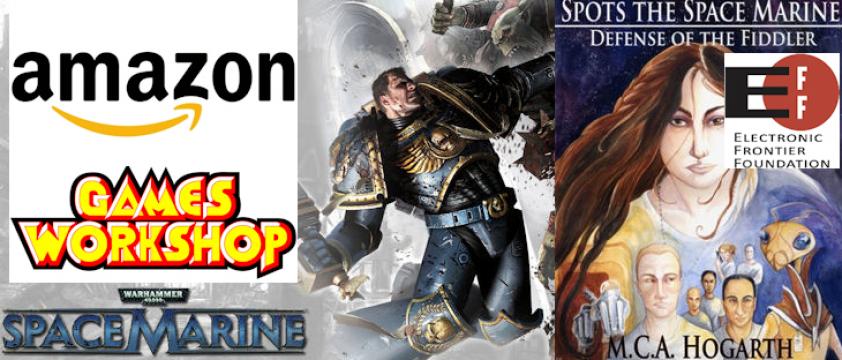
Most writers have then resorted to simply publishing ebooks and selling them online. What happens, then, when one minute you’re watching orders come in for your newly-published SciFi book, and the next, you get an email from Amazon saying that it’s been pulled out of the store for copyright infringement? This is exactly what happened to Maggie Hogarth, U.S.-based writer and author of “Spots the Space Marine”, whose book was pulled from Amazon’s shelves because she used the term “Space Marine,” a term that has apparently been held by U.K. toymaker Games Workshop.

The past few years have seen a rather large boom in the gaming industry, a fact that Gaming Realms, operators of Pocket Fruity, attributes to “the increased adoption of smartphones by consumers, which currently account for 17% of mobile usage, facilitated by increased mobile internet capabilities.” Because of this, many game developers and manufacturers are seeing a much heavier need to push for stronger intellectual property and copyright laws, as well as a better way to enforce them.

Games Workshop took things into their own hands when they had Amazon pull “Spots the Space Marine” from their virtual shelves, claiming that the firm had possessed a trademark for the term “space marine” since 1995. Ultimately, however, the writing community prevailed and “Spots the Space Marine” was reinstated, but not before Maggie Hogarth had lost months of potential sales.

But what happened to “Spots” shed light on a much graver issue: the lack of due process for takedowns in Amazon. “I continue to be gravely concerned by the lack of due process shown me,” Maggie wrote. “There’s a tradition of facing one’s accuser, and one of the worst parts of this ordeal was having no petition, no appeal, no right to defend myself and point out the absurdity of the claim against me.” To this day, guidelines for publication remain to be iron-clad and enforced with a passion; yet it’s surprisingly easy to find yourself being taken off of the shelves for reasons you may not be aware of.

Should you or anyone you know encounter any problems with publishing your work online, you might feel better knowing that there are foundations like the Electronic Frontier Foundation that have experience dealing especially with digital rights. It’s important to keep yourself updated, and always have a backup plan when it comes to publishing your work online.