Paganini’s Great Success Story

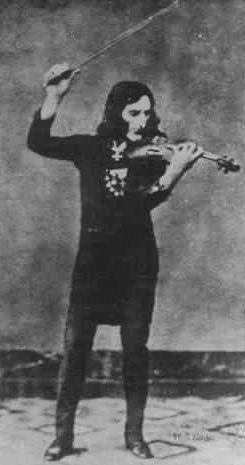
Nicoló PaganiniI was given a unique opportunity as an inspirational/motivational speaker last Sunday night. I spoke to 200 professional and accredited investors on my experiences with film investing. The opportunity allowed me to not only share my projects, but also allowed me to speak into the investor’s lives.

During my talk, I shared about how most great success stories come from people who aren’t passionate about making money, but rather are passionate about bringing change to their community, leaving a living legacy, and baring their soul through the arts. This awareness came after I learned about Nicoló Paganini and how his passion, not his investments, gave him a prominent place in history.

Paganini was a master violinist who played multiple string instruments. He started with the violin at age five and played his first public performance at age twelve. His passion for the art focused his training to the point where he could accomplish certain techniques that no one else could.

He was the first violinist who could play an entire octave without moving his hand position. He was also the first to play with a vigorous staccato. And, he eventually became known as the father of modern violin techniques.

These unbelievable techniques during the early 1800s caused his peers to rumor about him having sold his soul to the devil in order to accomplish what was not considered humanly possible.

While he had massive skill, it wasn’t the reason he excelled. His passion for his community, creating a legacy that would out live him, and for the art drove his success. This was proven out on numerous occasions, but one specific night went down in history.

His concert was moving along very well, but by the end of the second to last piece, one of his violin strings snapped as he played the final climatic note. The concert host was concerned and suggested that the concert come to a close since there was only one piece left. Paganini would not hear of it and before the host could suggest anything else to the contrary, Paganini started playing the last piece without having restrung his instrument.

The audience marveled as he sped up his fingering to compensate for the missing string. Awe filled each face as the music became more vigorous. The complexity of the music eventually overwhelmed the strings, causing the audience to gasp when a second string broke during the piece.

Paganini recalculated his fingering positions and continued without missing a single note. During the final crescendo that he played with great staccato, the third string broke. Without a moment of concern, Paganini played out the last few notes and bowed to a thunderous ovation.

After five minutes of applause, the host quieted the crowd and thanked the master violinist for his superb playing. But Paganini wasn’t ready to leave the stage. He stepped forward to the audience and reminded the fans that it was customary to play an encore for such a supportive audience. He then lifted his violin to his chin and played the most incredible piece of his career with one string.

Paganini’s passion for his community, his one concert that went down in history as a great legacy, and his passion for the art altered music. Historians share how Paganini’s performance was the turning point in music history that changed the way violins are played. There is a distinct difference in the lullaby type performance techniques prior to Paganini and the vigorous style that he introduced, making cinematic music like Indiana Jones and Star Wars possible.

His success was found within his passion and I encouraged each investor to not only consider how they manage their money, but to consider investing in the things that touch their passion as Paganini did. By doing so we are bound to touch those in our communities, leave behind a living legacy, and express our passion through the arts in a way that brings greater fulfillment into our lives.

Copyright © 2013 by CJ Powers

Why I Perform

With two feature film projects in development, you’d wonder why I’d take time to do improvisation and speaking engagements. The answer is simple: I want to understand actors. The only way I’ve found that allows me to get into the heads of the talent I hire is to become a performer on the side.

Two months ago, I was convinced by a friend to enter a Humorous Talk competition. It was a brutal experience that reminded me how vulnerable actors are. It made me want to protect them and their performance at any cost. The funny thing, I took first place and moved to the next level of competition, where I again took home a trophy.

The experience caused me a lot of turmoil. I mean, do you understand how hard it is to plan on being funny?

This was serious work, which isn’t funny in the least. It took everything I had for several weeks to appear funny in the moment. Thankfully, I was blessed with a crowd filled with belly laughter and my stories set off a chain reaction of joy like nothing I had experienced in life.

Last night was a bit different, as I performed a half hour improv show that turned into a 90-minute celebration of humor. That’s right, the show was scheduled for 30-minutes and the audience was laughing so hard that we tripled the length of the show.

The cast was made up of two Chicago improv instructors, two people from Second City, and a beautiful improviser from Brazil, and me. Magically we all clicked and came up with some of the funniest scenes in the moment, which frankly caused the performers to crack up too.

The show worked so well that one social beast from the audience was compelled to jump on stage in character and perform a ten second cameo, which caught everyone by surprise. Then it happened. The producer decided to try something unique. She invited every audience member to the stage to play an improv game. Only three people stayed in their seats. I had never seen anything like it.

The laughter and applause from both events, coupled with the insecurities of possibly making a complete fool of myself, made me realize that actors are a breed unto themselves. This level of experience gives me the perfect tools I need when I direct, which is exactly why I perform.

Copyright © 2013 by CJ Powers
All Rights Reserved.

Narratives Change Behavior

© Marek - Fotolia.comDaniel J. Siegel wrote a fascinating book titled, The Developing Mind. In his book, he points out a direct correlation between narrative and long-term memory. The process starts in the hippocampus and prefrontal parts of the brain, which captures autobiographical memory. Only a small portion of the memory will transfer to long-term memory.

The transference of the memory to permanent memory is based on a form of narrative, through cortical consolidation. This narrative is developed in small children in the second year of their life through interactions with their parents. The process of interacting that includes the sharing of their day with each other creates the transfer link to permanent memory.

The more a person interacts through the sharing of the story of their day, the more likely they will be able to narrate to themselves. When parents show an interest in their child’s day and allows the child to share his or her events, the process helps the child create free thought. The result is an ability for the child’s imaginings and the content of their memories to become an active part in their subconscious and conscious thoughts.

Filmmakers and preachers, to help their congregation or audience alter their behavior, can use this same narrative process. Shareable stories determine patterns of behavior or narrative enactments, which influences our subconscious thoughts – Leading to an altered state of mind.

This process can easily be seen in people working through issues or difficult decisions while in a dream state, watching guided imagery (like films), and journaling. This is possible because the process accesses more information from our minds and experiences than can be reviewed during purposeful introspection.

Preachers have shared for centuries that one of the best ways to break a reoccurring sin in our lives is to “confess our sins one to another.” This act is a form of narrative that can directly impact our decision making process and cause us to neutralize the impact or hold the temptation has in our lives – Setting us free and empowering us to make other choices.

The narrative process that can drop life-changing information into our long-term memory, which we use in decision-making, requires co-construction or interaction of some kind. It is a form of interpersonal communication that includes a person sharing and another person listening. A person of faith who believes God hears his or her prayers fits the process and helps the person develop more powerful decision-making abilities.

What I find fascinating is how narrative films can also alter coherent functioning through co-construction. Since the regular narrative process is based on social experiences and relationships, a movie can draw a person into the narrative through the use of strong visuals and emotional music to the point where the person is the listener in the conversation. The verbal and non-verbal reactions that the audience exhibits when bonded with the main character or protagonist, can create the false experience that the audience is also involved in the sharing, albeit vicariously – Not that our memories can distinguish the difference.

Film can thereby link and unify disparate memories to generate new behaviors, as if it originated within the core of a person’s thought process. This will directly impact future decisions to reflect the overlaying ideas determined by the media. In other words, the narrative process used in film can reorganize our thought patterns to create new mental models that strongly weigh in on our decision process.

To disarm negative inputs after watching a liberal movie, the person would have to journal or socially discuss the movie with another person. This conscious and purposeful approach would create a new narrative that will overwrite the first or at least put the first into memory as a negative element rather than a false positive element – Thereby empowering conservative decisions.

Both preachers and filmmakers have the ability to impact peoples’ behavior through narrative. The congregation and audience who receives the messages without consideration will store it in their memory as a good element for future decisions, but the person who consciously reviews the narrative in a social setting will be able to decide if it is remembered as a good or bad element. This empowers people to increase their memory with wisdom rather than foolishness.

It is no wonder that great spiritual movements have come from preachers using narrative. Nor is it a surprise that society has changed based on trends in the motion picture industry. Narrative is a powerful tool for changing behavior.

© 2013 by CJ Powers