Hollywood Attempts Victorian Steampunk

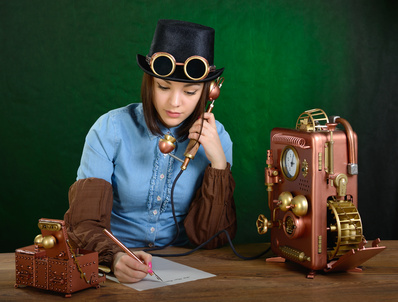
SteampunkThe title of this article is an oxymoron, as it’s impossible for the Hollywood machine to create anything that fits the Victorian Steampunk subculture. It would be just as bizarre for a large corporate sponsor to supply a Wild West Steampunk subculture. But, before I continue this rant, it might be prudent for me to explain what Steampunk is for those readers who haven’t heard of it.

Steampunk started out as a subgenre to science fiction, but grew into a living and growing subculture. Some Steampunk groups are based on the 19th Century British Victorian Era, while others lean more toward the American Wild West. Both groups focus on the industrialization era, but from an alternative post-apocalyptic period. Or, as some put it, from a retro-futuristic era.

While some Hollywood companies will attempt to borrow from the artistic look and feel of the subculture, there is a deeper heart that can’t be reproduced by mega business machines. The reason is simple: Steampunk is made up of creatives and thinkers who are into their own variety of steam punkery that they create or come upon in their life journey. In other words, Steampunks can’t be bought, nor are they impressed with “the man’s” fake punkery trying to be pushed on others.

The Steampunk culture is growing more secure and is being played out worldwide. This lifestyle brings with it a great deal of respect for each individual. Steampunks find ways to stand on his or her own two feet and create the tools needed for their personal entertainment and benefit. It’s no wonder that most Steampunks are artists, musicians, performers and other “strange” folk who think and create to fulfill the needs in their own life.

Most of the Steampunks that I’ve met have shared readily from their life journey and willingly learn any little thing that might help them and their communities. They are not into big brother, as they prefer the power to be local where their own intelligence can make a difference based on their community’s needs.

Most Steampunks can be found working for small companies or freelancing in teams. This matches the growing trend in corporate America where a group of small businesses come together for a major project, then once completed, will disband and regroup with another set of small businesses to accomplish something else. Even in the film industry we’re seeing numerous production companies coming together to make bigger films than what they could do on their own.

There are other key elements that play out in every Steampunk group, but I’d like to limit this article to Hollywood’s attempt at creating fake punkery. Just because something aesthetically looks like Steampunk, doesn’t make it Steampunk. Disney is known for its Steampunk Nautilus and Warner Brothers for its Steampunk filled Wild Wild West movie, both of which fit the industrialization Wild West America motif, but neither has the heart or understanding of what makes Steampunks who they are. Hollywood just doesn’t get it.

SteampunkOne of my favorite Steampunk websites, which truly lives up to true punkery in every sense, is Aurelia – Now in its second season. Created by a true Steampunk, Lisa England, the show is fully interactive in order to attract authentic Steampunks. The entire site is based on the thinkers and creators who participate. A single Hollywood type of person didn’t create it, but instead it was developed by a group of Steampunks doing what they do, and being who they are.

If it had been molded by Hollywood, it wouldn’t be authentic. If it were pushed by corporate America, it couldn’t be called Steampunk. This subculture is a grassroots movement that is embraced by Millennials, who already live lives consistent with Steampunks. The movement will therefore continue to grow and expand into the work world – Driving the development of more boutique sized companies.

Regardless, Hollywood will still attempt to put on their best false fronts in presenting some form of Victorian Steampunk, but they will also be confused when it flops. We’ve already heard the Hollywood issues with the faith based film subculture, which proved that Hollywood just doesn’t get it.
Copyright © 2014 by CJ Powers

News: Biased or Unbiased (Part 2)

© IvicaNS - Fotolia.comOne clue in determining the bias of a news story or message can come from human behavior. People have a tendency to take for granted the things that are common, typical, expected or even normal. On the other hand, people tend to point out the things that are different, out-of-the-ordinary, unique, or abnormal. Being human, many times a reporter’s word choice will reveal his or her bias along the same lines.

For instance, in a balanced story about politics, we’d most likely hear words about the “left-wing” and the “right-wing.” If the normal balance point were shifted left to a liberal bias, the comments would reflect the “mainstream” ideas and the “right-wing” ideas. By the same token, if what is considered normal to be shifted right to a conservative viewpoint, the comments would reflect the “mainstream” ideas and the “left-wing” ideas.

Word choice can also reveal the difference between a liberal editorial comment being stated as a fact versus a balanced factual detail. Sometimes what is not said is just as revealing.

As a national correspondent, Goldberg noticed how CBS identified conservatives as conservatives, but didn’t bother to identify liberals as liberals. “It sounds innocent enough, but why is it that Phillis Schlafly was identified as a conservative, but Catherine MacKinnon was not identified as a radical or feminist or a flat-left law professor or even as a plain old liberal? MacKinnon, after all, is at least as far to the left as Schlafly is to the right. Why was she simply a ‘noted law professor’? The clear implication was that Catherine MacKinnon is an objective, well-respected observer and Phyllis Schlafly is a political partisan.”[i]

Some times the opinion of the reporter is more obvious. Have we ever noticed the use of words like wacky, weird, wrong, bizarre, extreme right, scoundrel, sham, or scheme during an “objective” news story? When we do, we need to make sure it puts up a red flag in our mind that states we are hearing anything but an objective view. Certain words in of themselves cast a judgment of right or wrong and would not be used in a balanced news report.

Unfortunately the policing of words alone is not enough to protect our families from negatively biased messages. A good reporter may use all the right words while finding “experts” to speak with a bias that sides with what the report believes to be right. In reality, if a reporter looks hard enough, he or she will undoubtedly find an expert somewhere who will make the desired statement that needs to be presented.

It’s not that the newscaster is trying to purposely sway things to the left. He or she is merely attempting to do what feels right for the story. “The sophisticated media elites don’t categorize their beliefs as liberal but as simply the correct way to look at things.”[ii] If the media is convinced that it holds “the correct way to look at things” and society hears that perspective during every nightly newscast, it won’t take many years for the people to buy into the new perspective or what is considered normal. With that in mind, it doesn’t take long to understand how the perception of what is normal can creep through the years from the conservative right to the liberal left.

Pro-Choice

I’ll never forget the period of time when newscasters focused on pro-life people blocking abortion clinics to spare the life of the unborn. The footage showed police officers dragging “extremists” a way in an attempt to allow women their “right of free choice” to have an abortion. The pro-life perspective was presented as unconstitutional and many people bought into it.

A few years later I had several opportunities to meet women who had aborted their unborn babies. Besides their hearts being emotionally scarred, they all had one thing in common. Their attitudes revealed a deep desire to do just about anything to go back in time and correct the terrible mistake they had made. I couldn’t help but wonder why newscasters never told this side of the story.

With the understanding that I was possibly watching a biased reporter every time I turned on the news, I had to determine if the media was biased concerning abortion. Then it dawned on me, the word choice of the newscasters was “pro-choice” not “abortion.” I had discerned that a bias existed, one that redirected the perspective from life and death, to the freedom of choice.

Homeless

Since the media presents things in waves, we can check for bias by looking for an obvious pattern. Homeless stories in the news are a good example. I’ve noticed that each time a Republican president is in office, there are numerous homeless stories that pop up in the news. When a Democrat is in office, the number of homeless stories drops off significantly. “Homelessness ended the day Bill Clinton was sworn in as president. Which is one of those incredible coincidences, since it pretty much began the day Ronald Reagan was sworn in as president.”[iii]

Pedophiles

Looking for hype will also help us spot bias. Several years back, the FBI cracked a major case of pedophiles promoting child pornography on the Internet. Every network and major newspaper ran a story on how “some” of the abusers were Catholic priests. Shortly after the church stepped up to do something about it, the stories shifted to Presbyterian ministers.

Since it is extremely offensive to hear about a minister abusing children, a red hype flag should jump up in our mind. When I read these reports I asked myself who “some” of the other offenders were and then dove into researching the truth. It didn’t take long to learn that the smallest percentage of abusers were involved in ministry. I became more concerned to learn how many of the other offenders were police officers, judges, and public school teachers.

Nonetheless, the media felt it was important to point out the priests over the other categories of people. Many newscasters also showed disdain as they presented the stories. It was clear that they painted the priests as being wrong while letting the others off the hook. This silent language can give us a hint that there is an existing bias.

Unspoken

Silent languages like body language and other non-verbal communications can play an important role in the presentation. We all remember growing up and getting one of those looks from our moms as we were reaching for the cookie before dinner. Nothing had to be said; yet we immediately picked up on its full meaning.

By looking for visual clues, we’ll be able to detect how a newscaster might alter the meaning of a word with a simple glance, lifted eyebrow, or shrugged shoulder. The way the talent dresses, wears cosmetics, or speaks can also reveal a bias. As we’re watching the news, we might want to take a mental note of the facial expressions and eye movement and see if we can determine the messages being sent. As we do this, keep in mind that sometimes what is not done is just as powerful.

Copyright © 2014 by CJ Powers

[i] Bernard Goldberg, Bias (Washington, DC: Regnery Publishing, Inc., 2002), p. 56.
[ii] Ibid., p. 24.
[iii] Ibid., p. 71-72.

News: Biased or Unbiased

© IvicaNS - Fotolia.comDuring my 2013 media review, I was surprised to learn that 95% of all news stories were generated by seven companies. The vast majority of the viewers tuned in through outlets owned by the News Corporation, NBC Universal, and Time Warner. This is a bit disconcerting; as three companies decided what news events the public learned about and how that news would be presented.

I’m not suggesting that these three companies had a conspiracy plan in place to bias the news and swing the public to their views, but I am suggesting that the limited perspective is biased.

Veteran CBS reporter Bernard Goldberg suggested that extra effort doesn’t need to be exerted to lace a story with propaganda, since the liberal messages in the news just happen as a result of the reporter’s own beliefs and life styles. He states, “The old argument that the networks and other ‘media elites’ have a liberal bias is so blatantly true that it’s hardly worth discussing anymore. No, we don’t sit around in dark corners and plan strategies on how we’re going to slant the news. We don’t have to. It comes naturally to most reporters.”[1]

Since the news is a genre within the television industry, it is constrained by the parameters established within the arts and sciences of its production values. Simplified, television “is the act of transmitting information, ideas, and attitudes from one person to another.”[2] The person sending the message may or may not take a significant amount of time to mold or plan his or her message prior to it being sent.

Some times, like in the case of fast-breaking television news broadcasts, there is very little time to prepare the messages, let alone developing liberal angles for its presentation. The result is off the cuff news presentations as the information trickles in a little bit at a time, as was the case on September 11, 2001.

The first reporter I heard on that historic day suggested that up to 50,000 people might have been killed in the World Trade Center towers. Once more detail became available, the report was corrected to suggest that on any one given day there are approximately 30,000 people present in the towers. Within a couple of hours the report suggested that many individuals were evacuated, leaving about 6,000 in the towers’ remains. Days later, the number of individuals lost at ground zero dropped to around 4,000. A few weeks later, the final count of those who died in the attack on the World Trade Center was 3,016 people. Since then, the New York magazine puts the number killed in the attacks at 2,753.

Regardless of the slow stream of facts entering the newsroom, the reporter needs to continually fill time during a live broadcast in a professional manner. To accomplish this the newscaster must think quickly and come up with words off the top of his or her head. Since the best way of doing this is by drawing from experience, many comments will reflect his or her biased slant.

Normal Perspectives

Personal vocabularies and biases are readily drawn on to keep the pace of the news flowing to the public. This natural occurrence establishes what the viewer will perceive as “normal.” Since the viewers readily accept the media’s comments, the media becomes the decision maker of what is considered normal for our society.

I remember a psychology professor from my college days that continually challenged my perception of what was considered normal by our society. He shared what I understood to be the most outrageous liberal ideas I had ever heard. He even presented a bold stance by suggesting that each of his statements would become commonly acceptable in my lifetime.

I whole-heartedly disagreed. In my mind it wasn’t possible.  He said, “Men will admit to having sex with other men, rock and roll music will get darker and heavier,  abortion will become so common that many will use it as a form of birth control, and Disney will distribute R-rated films.”

Years later, my professor’s concept of normality had arrived. Men had come out of the closet, heavy metal music was released, Pro-Choice made abortions more easily assessable, and Disney released its first R-rated film (Down and Out in Beverly Hills 1986).

Changes in our societal views of normality will continue to evolve over time as it has in the past. And since “mass communications provides the very fabric with which our lives are ordered,”[3] it is important that we understand what the media says is normal.

The newscasters I’ve met believe they are normal people living in the mainstream of life. Their job is to simply inform viewers of the day’s events so we can make appropriate decisions as needed. But are they actually balanced people living normal lives? I think not.

When I was a director at WXOW-TV (ABC affiliate), I watched our lead news anchor receive perks when he ate at restaurants in town. Many times he complained about being in front of the camera and its curse of being a party waiting to happen the moment he entered a bar. People would flock to his familiar face and make unbelievable offers for favors or autographs.

After hearing more stories than I care to admit, I realized that he didn’t have a clue what a normal life was all about. And yet, his viewers continued to welcome his perspectives into their homes every night when they turned on the news.  He received calls, letters, and comments from people walking on the streets thanking him. Some would go a step further and comment on how much they trusted him.

I don’t believe newscasters are trying to dodge a balanced approach by consciously persuading us to their liberal perspective. His or her “liberal bias is the result of how they see the world.”[4] Many reporters see themselves as middle-of-the-road. Goldberg puts it this way, “If you hooked network news reporters and producers to polygraph machines and asked them, ‘Do you think you are guilty of liberal bias?’ most would almost certainly answer, ‘No.’ And they would pass the polygraph test because they’re not lying. They honestly believe what they’re saying.”[5]

This makes our job of protecting our families more difficult. We have to learn how to discern the reporter’s natural biases and blatant ones, separate from a balanced factual perspective. It would be much simpler if newscasters could truly be unbiased, or present both full sides of a story. But since they can’t, its up to each of us to learn how to discern the truth.

I’ll share some viewing techniques in Wednesday’s blog that will help us find the balanced perspective, while protecting our families from being mislead by the media.

Copyright © 2014 by CJ Powers


[1] Bernard Goldberg, Bias (Washington, DC: Regnery Publishing, Inc., 2002), p. 13.
[2] Warren K. Agee and others, Introduction To Mass Communications (New York: Harper & Row, 19??), p. 4.
[3] Ibid.
[4] Goldberg, p. 5.
[5] Ibid., p. 62.