What if, Jenner…

Caitlyn JennerCaitlyn Jenner was a name that caught my attention yesterday, as the name was extremely close to my daughter’s name, Caitlyn Jennifer. There are only two letters that make the names different and it spells the word “if”. So, it begged the question, “What if?”

The former Bruce Jenner introduced himself yesterday in the July issue of Vanity Fair magazine as Caitlyn Jenner. Her transgender story was greeted with numerous outlets responding in a politically correct manner. Jenner also received over a million followers on Twitter in support of her courage.

Transgender stories are not new to me. Having spent significant time in the film and television industry gave me great insights into the lives of many who struggle with being their “real” self. But, I learned more from my interactions with Tracy, who was once my cousin Tom.

Back in high school, Tom and I dated twins. They were both in the top ten of the most beautiful women in our school and their hearts were tender and their intelligence high. Tom and I didn’t know that we were dating sisters until we both picked up our dates at the same time on a Friday night.

Tom had what it took to connect with women and was raised in what I’d refer to as a matriarch. His mother was strong, bold and intelligent, wielding a lot of power in the community, while his dad was soft spoken and struggled to keep up with the other males in the family.

When he was a little preschool boy, Tom was invited to a little girl’s birthday party across the street. His mother provided him with a present to give the girl and hoped he would fit in, because he was the only boy present. Tom had no problem mixing with the girls and quickly picked up on what they liked and didn’t like.

Tom started to admire how the girls handled themselves and their discussions about their beautiful dresses. He longed to fit in and wished he too had a dress. When it came time to open presents, Tom was surprised and jealous to watch the girl open his gift, a beautiful new red dress that all the girls raved about. In that moment he determined that he too wanted a beautiful red dress.

Years later, I was invited to his house and was surprised to find him sitting in the living room in a pink and white dress. He shared with me his passion to become a woman and his need to get the full support of his family before proceeding. My mind reeled with “what if” questions.

Tom started the process that removed his facial hair and filled him with enough estrogen to alter his pecks into breasts. He also wore women’s clothing and had his Fortune 100 Company acknowledge him as a woman so he could use the woman’s restroom. The women on his floor were always careful about when they went to the restroom and some chose to use the facilities on another floor. It was awkward for most because Tom was physically still a man, albeit with small breasts.

In talking with several employees, I learned that being politically correct doesn’t emotionally protect women. Tom’s comments and his watchful eyes were still actively attracted to them. One woman explained that when Tracy began her physical journey, she was becoming an “unwelcome lesbian.”

On his deathbed, Tom told me that he was wrong and asked me to forgive him. He shared that his brain cancer was caused by his estrogen regime and he realized that God didn’t make a mistake when he was created. Tom shared that his wrong thinking developed a desire within his heart to be something he wasn’t and that he was foolish to follow his own warped thinking. He really didn’t want a red dress; he just wanted to fit in.

A year after his death, I spoke to a psychiatrist about Tom’s situation. The doctor told me that we think, then feel, then act. The way we choose to think causes us to develop feelings that we accept as real, because we feel them. Then, those supported feelings are acted upon.

THINK → FEEL → ACT

The psychiatrist also told me that we couldn’t feel anything without first thinking. Nor can our feelings change our thinking, but it can alter our actions. In other words, when we hit our thumb with a hammer our feelings cause us to cry out a phrase that we learned or thought about before the painful day ever arrived.

The person who cries out profanity most likely learned it by watching an adult’s reaction to a similar hit. In the same manner, the one who cries out “Jiminy Cricket,” learned to do so years earlier. Whether a pilot of a crashing plane calls out a profanity or calls to a deity, that person’s past will reveal what comes from his or her mouth in that split second – when there is no time to think up a politically correct statement, but only react.

With Jenner’s cover photo being seen by millions of people, I couldn’t help but to reflect back on Tom and wonder, “What if?”

In his last hours, Tom understood that the battle was not political, but within his own mind. He shared with me how his wrong thinking caused him to feel things that drove his actions, which ultimately took him farther away from who he really was.

So, what if Jenner realizes the same thing? Or, what if Jenner, after all the attention dies down, realizes that changing his physical appearance doesn’t help him to fit in any better than it did for Tom?

Copyright © 2015 by CJ Powers

Converting Speaking Fears into a Great Talk

It happened the night I crossed the stage during my talk. Halfway across, my foot stuck to something on the floor and jolted me to a stop. I attempted to lift my foot, but the sticky goo sucked it right back to the floor. I lifted it again using both hands and saw a sticky pink substance that adhered my shoe to the platform.

After swallowing my pride, I reached under my shoe and pried the sticky gum off. It was yucky and made my fingers stick together. I wondered where it had been before it ended up in my hands. Eew!

I pried and pulled, but nothing released the pink goo’s grip from my flesh. Then it dawned on me. When I was a little kid, I got balls of bubble gum from a penny dispenser and thought that rolling it might help set me free. I rolled the gum on top of itself in a circular motion.

The pink swirl formed into a little ball and it was no longer stuck to my hands. I lifted it up and admired the fun food from my childhood. Then I looked around and quickly popped it into my mouth to reminisce the full flavors from my youth. It was chewy.

Without thinking I started blowing little bubbles and popping it. I felt like a kid all over again, which gave me an idea. I blew out a long even breath and watched the bubble grow to four inches. I blew more forcefully and it grew to ten inches. I blew even harder and needed to hold the enormous bubble with both hands. It was huge.

I wondered if my childhood fear still resided within my bones and took a sharp object from my pocket. I stiffened as I raised the pin like object close to the bubble. Then I braced myself for the impact and pricked the surface.

BANG!

The make-believe bubble deflated in seconds and with it, my fears of public speaking.

Many of our fears as a young child are unfounded. Our prowess as adults gives a vantage point that helps us to understand our top two fears in life. The second, being the fear of death, and the first, public speaking.

In the moment when the giant bubble burst, I realized my new freedom. The fear of speaking had disappeared and I enjoyed giving the remainder of my talk. It was a revolutionary time, as I also understood the three steps to converting speaking fears into a great talk: fully participating in a speaking club; receiving encouragement from my peers; and, emulating my favorite speaker.

Participating in a speaking club started when I walked in for the first time. I was greeted with smiles, handshakes and warm welcomes. One woman suggested the best way to get a feel for the group was to dive in and give an impromptu talk, which I did with a bit of trembling. My question was easy to respond to based on my experiences and I filled the two-minute talk time with a simple life story.

I continued to give talks in each subsequent meeting in order to establish a pattern of speaking that would strengthen my skills through repetition. One woman saw my growth over a half dozen talks and recommended I compete in a humorous competition where I gave the talk that opened with me stepping in bubble gum.

Receiving encouragement from my peers over a dozen weeks gave me the courage to compete in the humor contest. It also empowered me to share several funny moments from my own life that had the audience laughing out loud. Receiving encouragement during my preparation gave me the confidence needed to face an audience and judges.

Those encouraging me made a significant difference in my approach and skill development. Their authenticity and affirmation supported me in taking risks that got me to the next level of competition and brought me to the moment when the fear of speaking disappeared, for which I’ll always be thankful.

Emulating my favorite speaker gave me a temporary confidence that allowed me to explore my own style of talk and storytelling. It forced me to learn my content well in keeping with the one I emulated.

This process helped me to quickly learn what techniques worked best for me and I soon found my voice in my word choices, content-based impromptu, and life stories. This gave rise to a new confidence that empowered me to step into that imaginary gum to kick off my talk.

It’s comforting to know the three steps to convert speaking fears into a great talk: fully participating in a speaking club; receiving encouragement from my peers; and, emulating my favorite speaker. I hope you will take this same journey and find yourself having a significant amount of fun in the talks you give going forward.

Copyright © 2015 by CJ Powers

The Dress becomes the Perfect Awareness Campaign

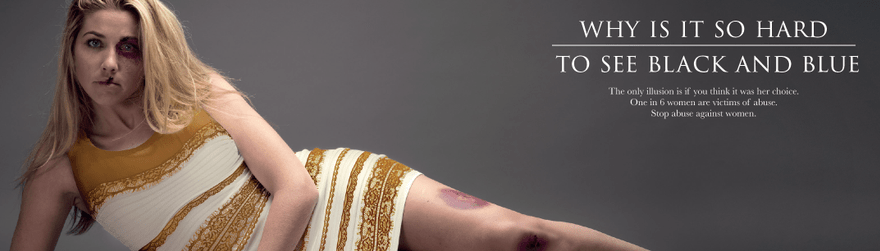
The Salvation Army Ad“Why is it so hard to see black and blue?” That was the slogan used by The Salvation Army in South Africa to bring awareness to abuse against women. It was released on the heels of “The Dress” that created worldwide arguments on the Internet. Some people saw the dress as white and gold, while others saw it as blue and black.

When I first learned about the dress I pulled it up on my cellphone and saw that it was indeed white with gold fringe. It was obvious. So obvious that I couldn’t understand why there were online arguments. When I got home that night I pulled up the photo on my iPad to see if I could better understand the argument. It was then that I was amazed. The dress I was looking at was obviously blue with black fringe.

I took time to research the phenomenon and was perplexed at how the image of the dress could appear more than one way. I went to take another look a couple days later and found a very impressive PSA by The Salvation Army. The picture had a woman in a white dress with gold fringe and the copy read, “Why is it so hard to see black and blue?”

The model was given black and blue bruises to help the symbolism of people not seeing those around them that are battered. The hint was subtle, yet powerful. It reminded me of a short film about people sitting in a church while boxcars filled with Jews were transported through their neighborhood to a concentration camp. No one acknowledged the sound of the train passing.

Anytime people look away from the ugly to continue living their comfortable life, many are abused. What is that phrase…”The only thing necessary for the triumph of evil is for good men to do nothing.”

The media plays a very important role in bringing awareness to society. Unfortunately the media chooses what to share and what not to share. We are no longer living in a day and age when all things are presented equally for us to make our own educated decision. Instead the media only use propaganda to sway our lifestyle to that of their choosing.

But today, I’ve decided to remind my readers that every year in America more women are beaten on Super Bowl Sunday than at any other time of the year. And, that the number one form of violence in America is domestic violence. That’s right. It’s not guns or gangs, but violence in the homes of our communities.

I recently watched a movie that suggested rifles be outlawed because 285 people were killed last year by a rifle. The numbers didn’t shake me since 1,490 died from domestic knife wounds and about 33,000 died in car accidents.

The Salvation Army did a great thing in bringing awareness by capitalizing on the free publicity that The Dress generated. Some estimated that the organization received the equivalent of $10MM in free advertising in South America and millions more worldwide by acting quickly.

Copyright © 2015 by CJ Powers