

Think about the place where you work and that one guy who always seems to come to the rescue with the latest problem-solving idea. You know the guy that I’m talking about. The one who your boss, after hours of worrying himself and making the team sick with concern, brags about his hero and takes him out for ice cream after he saves the day, again.
Have you ever wanted to be that guy?
Have you ever wanted the boss to recognize you for saving the team’s life like he does with that guy?
Well, I finally sat down with that guy and asked him how he consistently pulled off miracles for the boss. After taking copious notes, I’m sharing his process today. Here are the three ideas worth embracing to become a future hero in your boss’ eyes.
DEVELOP CREATIVE THINKING SKILLS
Everyone is creative, but few practice and hone their creativity. How do I know this? First, I can see it, because it’s physical. The left side of the brain processes logic and the right side, creativity. Since most everyone was born with both sides of their brain, they have the elements necessary for creative thought. Unfortunately, the school system teaches logic and sometimes frowns on the creative.
I’ll never forget the instruction I was given on the day we colored our first art project in kindergarten. The teacher gave us numerous rules to follow, which greatly limited my perspective. She told us the sky was blue and the grass was green. She even held up each of the crayons that she thought we should use to color the sky and grass.
This limited perspective stopped us from coloring an orange or purple sunset. It stopped me from mixing colors in an attempt to find the right version of green to match the different colors of grass that I saw in Illinois, Kentucky, Colorado, and Florida. It also stopped us from using a combination of three different green crayons to show the subtleties of grass in the shade and the bright sun.
Individuals who excelled at school developed the left side of their brain far more than their right side. Most of them received great accolades for their achievements, but they also received a negative seed that may have festered in their life over the years. That seed possibly grew into a belief that they were not creative.
A businesswoman recently shared how she sent her kids to the best schools so they could have a well-rounded mindset when they entered the job market. When I queried her on what she did to train her kids in creative thinking, she shared how she left play time up to the kids.
I asked what kind of a surgeon her son might be if she had him trained in the arts and left the development of medical knowledge to himself. She laughed and told me how silly I was for suggesting that someone could train themselves in surgery. I chuckled and suggested how silly it was to think her kids could train themselves in creative thinking, troubleshooting, and innovation.
If we want to be our business’ next problem-solving hero, we must intentionally develop our creativity. The more help we get from creativity gurus, the greater our opportunity to thrive creatively. For weekly opportunities to develop creativity, I recommend subscribing to my podcast, THE CREATIVE YOU, where everyone grows creatively. Every episode provides instruction and life application for work, home, and community. Learn more about the podcast or subscribe by clicking here.
LEARN THAT ALL IDEAS ARE WORTH BUILDING ON
Trouble-shooting discussions or brainstorming meetings require one functioning rule to be in place. The simple rule is that participants are not allowed to say anything negative or bad about an idea that’s put on the table for discussion. I get asked all too often why someone can’t point out that an idea was a really bad one.
Here are just a few of the things that happen when negative comments are made:
- Everyone becomes more hesitant to risk offering a suggestion.
- The focus shifts from a solution orientation to everything that won’t work.
- The condemned idea can no longer be used as a jumping off point to the solution.
- The positive energy and hope in the room turn to futility.
When participants share the mindset that all answers are good and we continue to look for the next best idea, everyone finds a way that they can improve upon the latest great idea.
Reading biographies of inventors from days gone by, I couldn’t help but realize that some of the brainstormed ideas that appeared foolish, were perfectly placed to reset the inventor’s mindset, leading him or her to something that they would never have considered, which led to their breakthrough. In other words, the “bad” idea was necessary to find the best idea.
During my creative coaching sessions, I teach students to think, “yes, and…” This mindset forces them to add to what has been presented and avoid taking away from any previous idea. The practice also makes the room a safe place for sharing ideas that might be on the edge of sanity like the original concept of creating an electric lightbulb.
GAIN CONFIDENCE IN YOUR CREATIVE ABILITIES
Creativity is a process that requires practice. The more hours a person puts into developing their creative skills, the more proficient they become. Also, the more a person plays with the mixing of concrete and intangible ideas, the easier the person will be able to create useful ideas and solutions in the workplace. The good news is that creativity can be developed and practiced in the mind as well as in the person’s physical surroundings.
One form of practicing creativity for real-world use includes the assessment of repetitive events that need to change. Since we know the cause of the problem, we are able to think about it in advance of when circumstances would typically play out, giving us time to change our actions in a way that impacts the natural outcome or scenario faced. Being armed ahead of time with a potential solution builds confidence.
Family events make a perfect example. Let’s say that food is always a part of family parties and Uncle Harry experiences gas issues after eating apple pie. And of course, Aunt Mabel always brings her famous apple pie. Since we know this will happen, we can practice our creativity by thinking through scenarios that could be instigated to make sure Uncle Harry gets a different dessert or Aunt Mabel is inspired to try making a blueberry pie—or a French Silk pie.
By creating a list of plausible cause and effect scenarios to accommodate a new outcome, there’s a far better possibility that the family would support an idea that ensures no gas is passed at the next party. Taking time to creatively plan ahead for a meeting or family event, we are able to build confidence with our plausible solutions and shine like a hero when the time is right. This type of practice will raise our confidence level because we’ll be prepared for the event.
Based on the above three points, it’s clear that creativity is not artistry.
Yes, artistry can take advantage of creativity, but creativity is not artistry. Creativity is a unique method of problem-solving that generates some form of innovation as a solution.
If the innovation is a product or marketable service, it might require a level of artistry for its promotion or packaging. However, creativity in of itself is not artistry, and once most people understand the distinctive difference, they are more likely to practice and grow their confidence in their newly developed creative skills.

 It was an amazing weekend for the box office. Independent film Beautifully Broken exceeded the film distributor’s (ArtAffects) lifetime box office gross (including adjustments for inflation for its previous titles) in its first weekend with just under $500K as a limited release. However, the small ad budget restricting the film’s promotions and the lack of available screens for expansion in this saturated market might kill the picture’s chance to surge this weekend. In other words, this weekend might be its last in theaters.
 Crazy Rich Asians was the biggest winner with a $25MM take at the box office. While most films’ ticket sales drop 35-60% during its sophomore weekend, Crazy Rich Asians fell less than 6%. This is in keeping with the new movement of audiences looking for lighter films with redemptive endings. You can read more about it in my post titled
  In my latest talk,
  I met Stacey Montgomery after one of her speaking engagements. She is a woman who believes strongly about empowering kids. She moved to the Chicago area from the east coast for school and stuck around after graduation due to her landing a great job. Since then she’s become an entrepreneur. I asked her how she transitioned to being an owner of a growing
 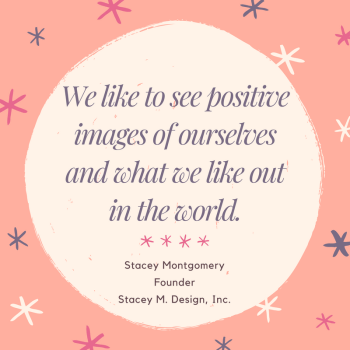 Her revelation focused her business pursuits on building the self-esteem of kids with diverse skin colors. She wanted her product line to encourage kids and build their confidence.
 CJ's Corner