The Right to Object

PCPolitical Correctness has made it “wrong” for me to have an opposing opinion, or at least voice it. Worse yet, it has empowered many to become PC police that attack anyone who voices contrary views, ruining companies, careers and friendships. This atmosphere has created an unsafe environment for vocalizing important matters, which has led to the longest period of silence by America’s majority.

The words, “…by the people and for the people…” once referenced what was good for the majority of Americans. The Senate was made up of professionals and the House was made up of commoners – Bringing all viewpoints to congress concerning important issues. Lobbyist groups now tell Congress how to vote on the bills they’ve provided, many of which were paid for by a few interested in controlling people at large.

But who’s to blame for this new form of controlling the masses?

THE JOURNALISTS

Sharyl Attkisson, an Emmy award winning investigative journalist, said the media is at fault. As a keynote speaker at the Right Online 2015, Attkisson shared how the once watch dog media has allowed the current administration to stop the proliferation of hard facts and replaced it with self-made pieces that alter the “truth.”

In her New York Times bestseller, “Stonewalled,” Attkisson describes that when the media sided with the politically correct, it was forced to drop facts from many reports. This led to the control of the media by the current administration that now limits the coverage of certain breaking stories to friendly biased reporters.

During her keynote, Attkisson shared how this led to the demise of trustworthy journalism and the reason she left the business. Today, she travels as a speaker sharing how “journalism is suffering from a crisis of it’s own making.”

THE MEDIA

After a recent interview on behalf of Amnesty International, the PC police attacked moderate Sir Patrick Stewart for his stance concerning Irish bakers who refused to put the words, “Support Gay Marriage,” on a cake. His comment during the interview was not questionable, as it brought balance to the subject.

“In my view, this particular matter was not about discrimination,” said Stewart, “but rather personal freedoms and what constitutes them, including the freedom to object. Both equality and freedom of speech are fundamental rights— and this case underscores how we need to ensure one isn’t compromised in the pursuit of the other.”

Some tried to discredit Stewart as being homophobic, but he has no issues with gay people. In fact, before the accusation, he had asked his openly gay best friend and cast mate, Sir Ian McKellen (X-Men, Lord of the Rings), to officiate his wedding to Sunny Ozell.

THE ENTERTAINERS AND EDUCATORS

Clint Eastwood was attacked publically for being politically incorrect behind the scenes. During the taping of the Spike TV’s Guys Choice Awards, Eastwood introduced “San Andreas” star Dwayne “The Rock” Johnson with a side comment about athletes who had transitioned into acting, including “Jim Brown and Caitlyn Somebody…” This political attack was purposeful, as his side joke never made it past the editing room floor, yet was used publically by the PC police to promote its agenda.

Jerry Seinfeld and other comedians have become increasingly nervous about their future with the PC police jumping on anything that might leverage their agenda. Comedy has always risen from our pain or circumstances, but in recent years universities push so much political correctness that it stops comedians like Chris Rock and The Cable Guy from performing at those venues.

THE REAL ANSWER

It’s the people who decide if we are to show respect to those with opposing opinions or not. Our government officials have to conform to the needs of the majority when they are not silent. Our journalists must provide the facts and not bias when the majority demand it. And, for freedom of speech and humor to exist, we must allow our comedians to experiment without being judged.

The one really at fault are those who jump on the bandwagon of joining the PC police instead of standing for freedom of speech. As a communicator, I hope more people start to listen to all the arguments and not hinder any from being made. After all, had political correctness been instituted back in the 50s and 60s, we would never have learned that smoking was bad for our health.

Copyright © 2015 by CJ Powers
Over Cranking Beauty Shots

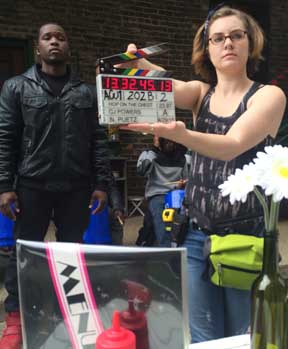
Hop On The ChestHave you ever wondered why the female lead always looks stunning during an intimate heartfelt moment in a Hollywood film, but not in an independent film? It has a lot to do with the type of director at the film’s helm – artistic or techie.

There are several clear distinctions between the talents of a director with a techie background and one with an artistic background. The techie guy typically has a history of using technology to glitz up his film with cool imagery, while the artistic guy focuses on story, emotions, and rhythm.

When its time for close-ups, the techie director uses the same lighting and lens set up as he used for the medium shot or the over the shoulder shot. The artistic director hates to see the camera team just tighten the shot and instead suggests a significantly heightened set up to explore the feelings of the moment.

One of my favorite techniques is over cranking the film. Or, for those with a video only background, shooting more frames per second. The technique is ideal for those heartfelt moments when the director needs a beauty shot or a graceful close up of the female lead.

I tend to ask my DP (Director of Photography) for a more muted lighting set up to help enhance the over cranking shot. The softer lighting bends gently around the woman’s face and diffuses any harsh shadows that would otherwise be present. A soft filter might also be added to the camera to makes sure that there are no sharp edges.

If the camera is shooting at 24 fps (frames per second), I have the DP bump it up to 32 fps. This increases the clarity of the shot, while taking off the rough edges. By clarity, I’m not referring to sharpness of image, but rather the avoidance of extra blur inherent in capturing motion.

More importantly, by adjusting the speed by about 30% the image is captured with more detail within the actor or camera’s motion. This translates to an image with a great fluid movement during playback. Directors all have their own set of percentages for capturing a beauty shot, but I’ve found mine to be emotionally effective for all audiences.

In post-production, the 32 fps are then played back at 24 fps to generate a far more graceful shot of the female lead than was present on set. That ideal graceful cinematic shot can only be achieved with special diffused lighting, slightly soft focus lens and adjusted speed of film with readjusted playback.

The techie director tends to avoid the elaborate set up for the beauty shot by just slowing down the image in post. However, he can never get close to capturing that same dreamy and graceful effect that comes from the in camera artistry created on set by the camera team.

This one difference between a techie director and an artistic director is magnified when considering all the other techniques artists master that techies rarely learn.

The cumulative sum of these parts or production elements is what creates the uniquely different look between a Hollywood produced picture versus an independent picture. This focus on detail requires time and a budget for talented people in order to capture the beauty shot that everyone remembers from the film, but can’t explain why.

Copyright © 2015 by CJ Powers

What if, Jenner…

Caitlyn JennerCaitlyn Jenner was a name that caught my attention yesterday, as the name was extremely close to my daughter’s name, Caitlyn Jennifer. There are only two letters that make the names different and it spells the word “if”. So, it begged the question, “What if?”

The former Bruce Jenner introduced himself yesterday in the July issue of Vanity Fair magazine as Caitlyn Jenner. Her transgender story was greeted with numerous outlets responding in a politically correct manner. Jenner also received over a million followers on Twitter in support of her courage.

Transgender stories are not new to me. Having spent significant time in the film and television industry gave me great insights into the lives of many who struggle with being their “real” self. But, I learned more from my interactions with Tracy, who was once my cousin Tom.

Back in high school, Tom and I dated twins. They were both in the top ten of the most beautiful women in our school and their hearts were tender and their intelligence high. Tom and I didn’t know that we were dating sisters until we both picked up our dates at the same time on a Friday night.

Tom had what it took to connect with women and was raised in what I’d refer to as a matriarch. His mother was strong, bold and intelligent, wielding a lot of power in the community, while his dad was soft spoken and struggled to keep up with the other males in the family.

When he was a little preschool boy, Tom was invited to a little girl’s birthday party across the street. His mother provided him with a present to give the girl and hoped he would fit in, because he was the only boy present. Tom had no problem mixing with the girls and quickly picked up on what they liked and didn’t like.

Tom started to admire how the girls handled themselves and their discussions about their beautiful dresses. He longed to fit in and wished he too had a dress. When it came time to open presents, Tom was surprised and jealous to watch the girl open his gift, a beautiful new red dress that all the girls raved about. In that moment he determined that he too wanted a beautiful red dress.

Years later, I was invited to his house and was surprised to find him sitting in the living room in a pink and white dress. He shared with me his passion to become a woman and his need to get the full support of his family before proceeding. My mind reeled with “what if” questions.

Tom started the process that removed his facial hair and filled him with enough estrogen to alter his pecks into breasts. He also wore women’s clothing and had his Fortune 100 Company acknowledge him as a woman so he could use the woman’s restroom. The women on his floor were always careful about when they went to the restroom and some chose to use the facilities on another floor. It was awkward for most because Tom was physically still a man, albeit with small breasts.

In talking with several employees, I learned that being politically correct doesn’t emotionally protect women. Tom’s comments and his watchful eyes were still actively attracted to them. One woman explained that when Tracy began her physical journey, she was becoming an “unwelcome lesbian.”

On his deathbed, Tom told me that he was wrong and asked me to forgive him. He shared that his brain cancer was caused by his estrogen regime and he realized that God didn’t make a mistake when he was created. Tom shared that his wrong thinking developed a desire within his heart to be something he wasn’t and that he was foolish to follow his own warped thinking. He really didn’t want a red dress; he just wanted to fit in.

A year after his death, I spoke to a psychiatrist about Tom’s situation. The doctor told me that we think, then feel, then act. The way we choose to think causes us to develop feelings that we accept as real, because we feel them. Then, those supported feelings are acted upon.

THINK → FEEL → ACT

The psychiatrist also told me that we couldn’t feel anything without first thinking. Nor can our feelings change our thinking, but it can alter our actions. In other words, when we hit our thumb with a hammer our feelings cause us to cry out a phrase that we learned or thought about before the painful day ever arrived.

The person who cries out profanity most likely learned it by watching an adult’s reaction to a similar hit. In the same manner, the one who cries out “Jiminy Cricket,” learned to do so years earlier. Whether a pilot of a crashing plane calls out a profanity or calls to a deity, that person’s past will reveal what comes from his or her mouth in that split second – when there is no time to think up a politically correct statement, but only react.

With Jenner’s cover photo being seen by millions of people, I couldn’t help but to reflect back on Tom and wonder, “What if?”

In his last hours, Tom understood that the battle was not political, but within his own mind. He shared with me how his wrong thinking caused him to feel things that drove his actions, which ultimately took him farther away from who he really was.

So, what if Jenner realizes the same thing? Or, what if Jenner, after all the attention dies down, realizes that changing his physical appearance doesn’t help him to fit in any better than it did for Tom?

Copyright © 2015 by CJ Powers