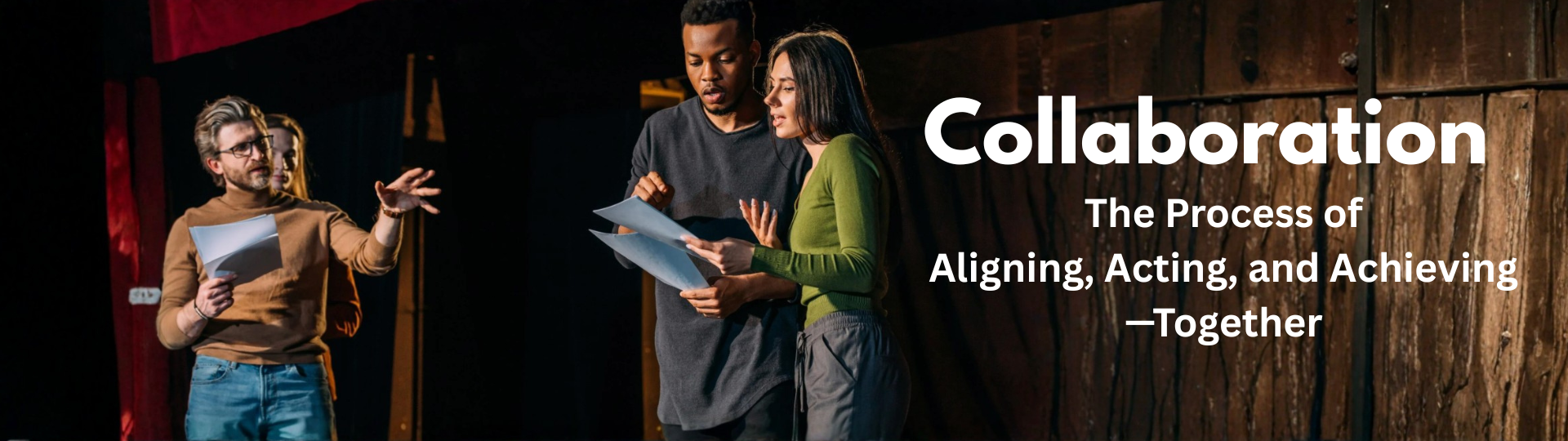
Collaboration is often spoken about as a goal, but rarely understood as a process—much less an enjoyable one.
Many teams assume collaboration happens when people agree, attend meetings, or divide up tasks. But agreement alone doesn’t move things forward, and activity without direction only creates motion, not progress.
True collaboration, the kind that produces meaningful results, requires something more intentional.
Director to Director: Learning Collaboration the Hard Way
Years ago, I took another directing class. I already had several TV shows and films under my belt. Still, I wanted to learn a few techniques from a director who had won numerous awards for directing shows on the legitimate stage. Her work was brilliant, and I knew some of her techniques would transfer.
Before our first class, knowing my background, she suggested that there was nothing she could teach me that I didn’t already know. I assured her that I’d be happy if I learned one technique that could improve my skill set. She agreed to teach me under the condition that she could ask me questions about film and television so she could learn from me as well.
After the first month of classes, she suggested I learn to collaborate better with my actors and crew. While she enjoyed watching the outcome of my directing, she suggested I could have more fun and dive a bit deeper into the script through a balanced view of collaboration.
Her suggested form of collaboration follows a simple, but demanding pattern. Progress happens when people align, act, and achieve—in that order.
ALIGN: Collaboration Begins With Shared Direction
Sharing elements of direction was hard at first. As a director, the vision started with me, and most of the time, my direction was the only direction provided. However, my instructor suggested that, while I have a complete understanding of the entire show, the actors know their characters’ subtleties better.
The costume designer, while she quickly picked up my vision, was the one who sculpted the final wardrobe. The same concept applies to the property master, the set designer, and all other department heads. Each one had to pass direction on to their teams, but first had to capture my approval.
When I realized that the department heads could all share some form of direction, I was able to work smarter, not harder. Their direction just needed to align with mine.
Alignment is the most overlooked and most critical step in collaboration.
To align means ensuring everyone is oriented toward the same outcome before action begins. It’s not about unanimous agreement or identical thinking. It’s about shared understanding.
I gave it a try. At first, each person had interpreted my vision a bit differently. Some were focused on the heart of the character transformation. Others prioritized the show’s visual quality. A few were motivated by what made them look good, even if their ideas didn’t fit the show.
Without alignment, a predictable pattern emerges: activity fragments, energy scatters, and frustration grows quietly.
Alignment requires slowing down long enough to ask:
- What are we actually trying to achieve?
- Why does this matter?
- What does success look like together?
Once we named these answers out loud, something shifted. The tension in the room eased, not because conflict disappeared, but because clarity arrived.
Alignment doesn’t eliminate differences. It gives them a common direction. At that point, everyone felt heard and understood. When I had to turn down some ideas due to focus or vision, everyone aligned their ideas because we had become a cohesive team, and no one wanted to break the show.
ACT: Collaboration Comes Alive Through Ownership
Action is where collaboration becomes real—or reveals itself as theoretical.
Once alignment is established, movement must follow. But collaborative action isn’t about assigning tasks and hoping for the best. It’s about shared ownership and visible contribution.
Once the production team aligned on the outcome, we stopped debating ideas and started committing to actions. Roles became clearer. Deadlines became meaningful. Accountability became mutual instead of managerial.
Action requires trust. It asks people to step forward, not wait to be told. It also requires restraint—knowing when to act independently and when to coordinate.
Collaboration stalls when people wait for permission. It accelerates when people take responsibility within shared clarity.
The careful blending of these ideas creates a better show than any single person’s vision. In this case, mine.
ACHIEVE: Collaboration Is Measured by Results, Not Effort
Achievement is the natural byproduct of aligned action—but it’s often misunderstood.
Many teams celebrate effort. Fewer take the time to evaluate outcomes.
Achievement doesn’t mean perfection. It means progress that can be named, measured, and learned from. It gives collaboration credibility.
When our team finally delivered the initiative, it wasn’t flawless—but it was real. And because we reflected together afterward, the achievement became more than a result; it became a shared reference point for future collaboration.
The live audiences made it clear that something special had emerged from our production. Not because I was a great director, but because I learned how to collaborate and draw the best out of each person on my team.
Achievement reinforces trust. It proves that working together was worth the investment. It also feels good. Everyone in the cast and crew told me they would work with me again, anytime I needed them. Our joint achievement came from the trust we had instilled in each other.
Collaboration Requires Intention
Collaboration is not a personality trait or a meeting format. It’s a discipline.
When collaboration fails, it’s rarely because people didn’t care enough. More often, it’s because they skipped a step—acting before aligning, or celebrating effort without achieving clarity.
Strong collaboration asks us to slow down early, step up fully, and reflect honestly.
Take a moment to consider the spaces where you collaborate—at work, in leadership, or within your community.
- Are you aligned on what truly matters?
- Are you acting with shared ownership?
- Are you achieving outcomes you can learn from together?
Progress doesn’t happen by accident. It happens when we choose to align, act, and achieve—intentionally, patiently, and together.
Copyright © 2026 by CJ Powers
 CJ's Corner