Story, Structure and Style

© ktsdesign - Fotolia.comMentoring in the moment is an important function of giving back. Not only does it give me an opportunity to help new upcoming filmmakers move up a level in the business, but it also gives me a fresh perspective on what unforeseen industry changes might be slowly approaching.

In a recent conversation with a young female director, I was asked, “What are the three most important things that a director brings to a script?” After answering, I realized that there are indeed three specific things a director brings to a script that determines the success of a film.

STORY

The director brings the story to life by attaching his vision to it. He is responsible for finding the holes in the story and making it whole. He also has the power to determine how it is to be told and position it so the audience can easily understand and embrace it. If the story fails, it’s the director’s fault.

One first time director argued the point with me by suggesting he was not at fault, but his bad writer was to blame. I asked him if he was sure and he confidently defended his position. Once I could see that he put his entire defense into the bad writer, I asked why he chose to make the film when he knew the writing was so bad. His argument proved him to be either a bad director or a foolish one for shooting an unworthy story.

STRUCTURE

The director determines the beats of the film and the visuals that will best depict the story. He is responsible for the development of the characters and the emotional highs and lows of the picture. He even holds the responsibility to inspire his team to perform admirably within the confines of the budget.

An experienced director with 35 plus features under his belt told me that he left the structure of the film to the writers and director of photography, while he focused solely on the actors. I asked him how the film was translated from the page to the screen without his artistic touch. He suddenly realized that he had given up his artistic choices to chance happenings – When the written word happened to match well with the visual depiction.

STYLE

All directors have an artistic style that evolves into something that few can replicate. When a person watches a Woody Allen movie, everyone knows it’s his, even if his name was left out of the credits. Just sharing director names at a party immediately invokes the look, feel and overall style of his work within the person’s mind. Consider Hitchcock, Spielberg, and Nolan. It’s hard to say those three names without seeing their style show up in your mind’s eye.

I recently chatted with an up coming director who was struggling with his first short film. Every time someone helped him improve his story, he lost interest in it and started over. I realized that something about the suggestions must have spun the style of his show within his mind to become something he was no longer passionate about. This was disconcerting since directors always spin the suggestions into their own version that matches their stylistic vision.

Directors put their fingerprint on everything they do. It shows up in the perspective from which the story is told to the structure of its emotional beats to the overall look and feel that is presented. The director owns the success of a film and has the three key tools that place his fingerprint onto his work.

Copyright © 2015 by CJ Powers

The Right to Object

PCPolitical Correctness has made it “wrong” for me to have an opposing opinion, or at least voice it. Worse yet, it has empowered many to become PC police that attack anyone who voices contrary views, ruining companies, careers and friendships. This atmosphere has created an unsafe environment for vocalizing important matters, which has led to the longest period of silence by America’s majority.

The words, “…by the people and for the people…” once referenced what was good for the majority of Americans. The Senate was made up of professionals and the House was made up of commoners – Bringing all viewpoints to congress concerning important issues. Lobbyist groups now tell Congress how to vote on the bills they’ve provided, many of which were paid for by a few interested in controlling people at large.

But who’s to blame for this new form of controlling the masses?

THE JOURNALISTS

Sharyl Attkisson, an Emmy award winning investigative journalist, said the media is at fault. As a keynote speaker at the Right Online 2015, Attkisson shared how the once watch dog media has allowed the current administration to stop the proliferation of hard facts and replaced it with self-made pieces that alter the “truth.”

In her New York Times bestseller, “Stonewalled,” Attkisson describes that when the media sided with the politically correct, it was forced to drop facts from many reports. This led to the control of the media by the current administration that now limits the coverage of certain breaking stories to friendly biased reporters.

During her keynote, Attkisson shared how this led to the demise of trustworthy journalism and the reason she left the business. Today, she travels as a speaker sharing how “journalism is suffering from a crisis of it’s own making.”

THE MEDIA

After a recent interview on behalf of Amnesty International, the PC police attacked moderate Sir Patrick Stewart for his stance concerning Irish bakers who refused to put the words, “Support Gay Marriage,” on a cake. His comment during the interview was not questionable, as it brought balance to the subject.

“In my view, this particular matter was not about discrimination,” said Stewart, “but rather personal freedoms and what constitutes them, including the freedom to object. Both equality and freedom of speech are fundamental rights— and this case underscores how we need to ensure one isn’t compromised in the pursuit of the other.”

Some tried to discredit Stewart as being homophobic, but he has no issues with gay people. In fact, before the accusation, he had asked his openly gay best friend and cast mate, Sir Ian McKellen (X-Men, Lord of the Rings), to officiate his wedding to Sunny Ozell.

THE ENTERTAINERS AND EDUCATORS

Clint Eastwood was attacked publically for being politically incorrect behind the scenes. During the taping of the Spike TV’s Guys Choice Awards, Eastwood introduced “San Andreas” star Dwayne “The Rock” Johnson with a side comment about athletes who had transitioned into acting, including “Jim Brown and Caitlyn Somebody…” This political attack was purposeful, as his side joke never made it past the editing room floor, yet was used publically by the PC police to promote its agenda.

Jerry Seinfeld and other comedians have become increasingly nervous about their future with the PC police jumping on anything that might leverage their agenda. Comedy has always risen from our pain or circumstances, but in recent years universities push so much political correctness that it stops comedians like Chris Rock and The Cable Guy from performing at those venues.

THE REAL ANSWER

It’s the people who decide if we are to show respect to those with opposing opinions or not. Our government officials have to conform to the needs of the majority when they are not silent. Our journalists must provide the facts and not bias when the majority demand it. And, for freedom of speech and humor to exist, we must allow our comedians to experiment without being judged.

The one really at fault are those who jump on the bandwagon of joining the PC police instead of standing for freedom of speech. As a communicator, I hope more people start to listen to all the arguments and not hinder any from being made. After all, had political correctness been instituted back in the 50s and 60s, we would never have learned that smoking was bad for our health.

Copyright © 2015 by CJ Powers

Over Cranking Beauty Shots

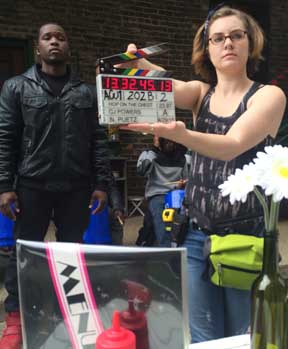
Hop On The ChestHave you ever wondered why the female lead always looks stunning during an intimate heartfelt moment in a Hollywood film, but not in an independent film? It has a lot to do with the type of director at the film’s helm – artistic or techie.

There are several clear distinctions between the talents of a director with a techie background and one with an artistic background. The techie guy typically has a history of using technology to glitz up his film with cool imagery, while the artistic guy focuses on story, emotions, and rhythm.

When its time for close-ups, the techie director uses the same lighting and lens set up as he used for the medium shot or the over the shoulder shot. The artistic director hates to see the camera team just tighten the shot and instead suggests a significantly heightened set up to explore the feelings of the moment.

One of my favorite techniques is over cranking the film. Or, for those with a video only background, shooting more frames per second. The technique is ideal for those heartfelt moments when the director needs a beauty shot or a graceful close up of the female lead.

I tend to ask my DP (Director of Photography) for a more muted lighting set up to help enhance the over cranking shot. The softer lighting bends gently around the woman’s face and diffuses any harsh shadows that would otherwise be present. A soft filter might also be added to the camera to makes sure that there are no sharp edges.

If the camera is shooting at 24 fps (frames per second), I have the DP bump it up to 32 fps. This increases the clarity of the shot, while taking off the rough edges. By clarity, I’m not referring to sharpness of image, but rather the avoidance of extra blur inherent in capturing motion.

More importantly, by adjusting the speed by about 30% the image is captured with more detail within the actor or camera’s motion. This translates to an image with a great fluid movement during playback. Directors all have their own set of percentages for capturing a beauty shot, but I’ve found mine to be emotionally effective for all audiences.

In post-production, the 32 fps are then played back at 24 fps to generate a far more graceful shot of the female lead than was present on set. That ideal graceful cinematic shot can only be achieved with special diffused lighting, slightly soft focus lens and adjusted speed of film with readjusted playback.

The techie director tends to avoid the elaborate set up for the beauty shot by just slowing down the image in post. However, he can never get close to capturing that same dreamy and graceful effect that comes from the in camera artistry created on set by the camera team.

This one difference between a techie director and an artistic director is magnified when considering all the other techniques artists master that techies rarely learn.

The cumulative sum of these parts or production elements is what creates the uniquely different look between a Hollywood produced picture versus an independent picture. This focus on detail requires time and a budget for talented people in order to capture the beauty shot that everyone remembers from the film, but can’t explain why.

Copyright © 2015 by CJ Powers