
Monthly Archives: March 2013
The Production Trinity
Great films start with great writing, but the trinity formed by the director, director of photography, and the production designer create high production values – Giving rise to excellence. Without the trinity, films can’t surpass the quality of an average B movie.
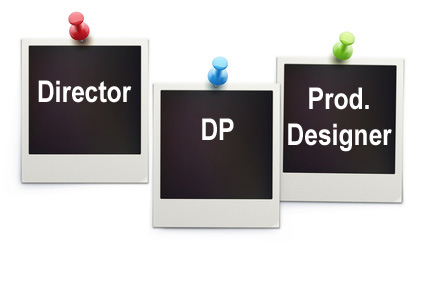 Cost cutting methods used by many independent films includes the merging of the director and the DP into one person, leaving out the production designer all together. While a few films lacking a trinity have been remarkable, most can’t compete in the marketplace. This is due to the low production values and shortcuts that occur because there isn’t enough manpower.
When a creative trinity is a part of a production, the focus on detail plays out in the following three ways:
DIRECTOR: The director owns the vision for the film and needs to have a strong opinion on what the film will be. He is responsible for how the story is told visually with a specific point of view. He must have a strong sense in how to translate the written word (screenplay) to the screen cinematically. His focus covers the story, characters, motivation, technical and aesthetics – The over all look and feel of the film. His point of view will determine how the tools of the trade are applied to the story. He also collaborates with the department heads and makes all final decisions on design and photographic elements.
PRODUCTION DESIGNER: Being the head of the Art Department, the designer is in charge of the physical environments: The creation, construction and selection of sets and locations. He also oversees the costume designer, wardrobe, hair and make-up. His team focuses on the period, space, texture and colors. In preproduction, he collaborates with the director to understand his impression of the story and how he will pull it together.
DIRECTOR OF PHOTOGRAPHY: The DP or Cinematographer is responsible to capture the director’s vision on film/video. His collaboration with the director and production designer is for the purpose of creating the look and visual style of the film that best serves the director’s vision. He oversees a team that covers the camera, composition, lighting, and movement. The choice of equipment, lenses, processes, and digital enhancements determine the perspective, color and visual texture of the story.
The trinity sometimes uses previs, a tool/technique to pre-visualize scenes, to make sure they clearly understand the same visual story elements. Some trinities use software for pre-visualization, others use storyboards or animatics, and some use models and miniatures. I’ve actually used a combination of tools, not to mention my own technique for camera placement within my blocking charts.
Whenever the exact right combination of artists forms the trinity there are normally a lot of award ceremonies that follow. The amount of high quality detail is also talked about by the audience, which typically generates a buzz that leads to an increase at the box office.
Copyright © 2013 by CJ Powers
Ragman – Review
Walter Wangerin Jr. wrote a heart felt short story in 1984 that took the world by storm. It moved youth to understand what Christ did for their generation. The essence of the story helped thousands to comprehend, for the first time, the sacrifice that Christ made to bring healing into their lives, if they were willing.
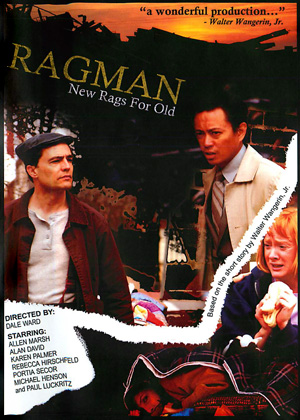 Great literary works of this kind seldom translate well to the screen, yet Director Dale Ward took on the challenge with his 2009 film version. While the film doesn’t stir the emotions as powerfully as Wangerin’s written work, it’s a close rendition of what was written. For those not having ever seen one of the Ragman films, I recommend you share Ward’s work with your family and take advantage of his study guide. Or at least get a copy of the book.
Ward is an Emmy award winner in his own right, so it wasn’t surprising to learn that the film was a finalist in several film festivals. It won Best Faith-Based Film at the Cape Fear Film Festival and was a Taffy Award Winner at the Reno Film Festival. I attribute most of this success to the production team starting with a great story from a National Book Award recipient.
The greatest problems facing the translation work of taking a great piece of literature to the screen, is deciding if it’s important to move the audience emotionally in the same way as the story, or keep the story intact. No, it’s not possible to do both – They are two different types of media.
Wangerin’s literary work is based on the journey of the reader’s heart. Film’s are based on the journey of the protagonist. Books allow the reader to envision the characters from their own perspective, based on personal experiences, making the story far richer than anyone could expect. A film is limited to the director’s perspective, which might be extremely rich or not, depending on the level of risk he takes in making it for the screen.
A good example of this can be found in Ragman. The director chose to work with a lot of long shots, while my heart desired to move in close and get to know each character’s plight and what was behind it. I needed to feel and understand each person’s pain, but I was limited to gain just enough insights for the climax of the film to work. The original short story, thanks to Wangerin’s craftsmanship and my creativity, gave me far more to work with – Creating an incredible heart changing experience in my own life.
However, Ward did a good job in his depiction of the story and it’s worth watching, especially if you haven’t ever been touched by the story in any of its forms. The film is 18 minutes in length and can be found on Amazon.
 CJ's Corner